
I’m writing this because I’ve been living it.
Over the last couple of weeks, I set up Mac minis for each of my businesses. I started with my own setup first.
Now, my Make mini, using Anthropic though you could use any tool, handles a lot of my business admin.
It does my reconciliation, checks my accounts, and makes sure everything is on track.
It helps with all the small admin tasks I need to keep the business running smoothly, like looking through emails and checking for any issues I need to handle for tax, legal, or governance reasons.
This got me thinking about where things might head.
Right now, the models we’re using are already a bit old, Opus 4.6, for example.
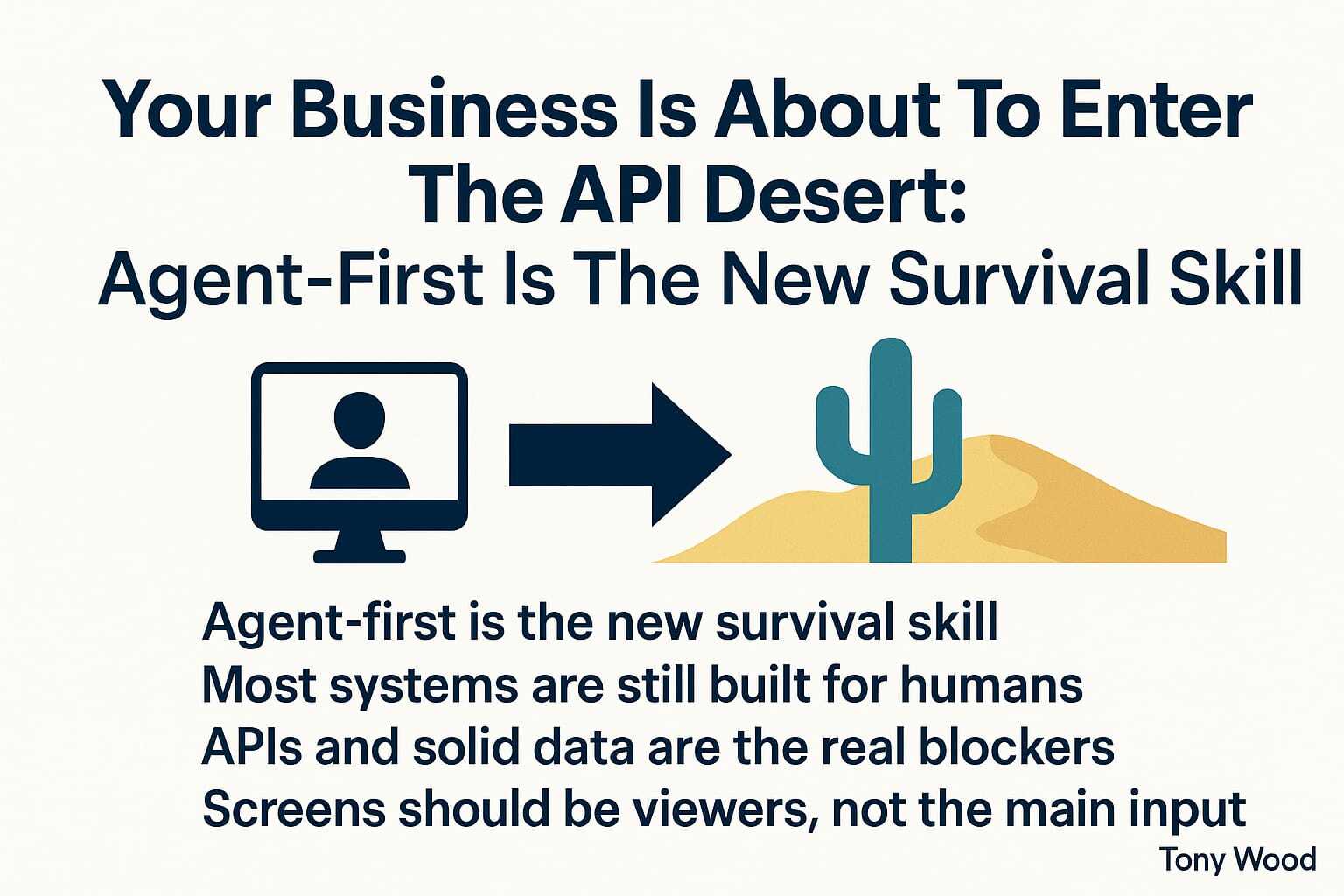
But looking ahead, the real blockers are that these systems are still built for humans first.
Imagine if my entire banking system was just an API (application programming interface).
I wouldn’t need a screen, though there should still be a way for a human to view it if needed.
The main input would be the API, with the interface as more of a viewer or modifier.
Maybe we’ll see more systems designed agent-first, similar to how we had mobile-first and web-first approaches in the past.
Now, it could be agent-first.
This raises an important point.
If you haven’t got solid data or can’t create an API, you’re not going to be able to participate in this new landscape.
It’s a bit like when not having a website or mobile app meant you barely existed as a business.
Now, if you aren’t agent-first, you risk not existing at all.
It’s fascinating to watch.
I’m curious how people will adapt.
Agentic (AI created research and content)
This is the part leaders tend to miss: agent-first is not a tool choice, it’s a design choice.
If your systems are built to be clicked, scrolled, and manually checked, then your organisation stays dependent on human attention.
If your systems are built to be called, queried, and verified, then your organisation can run agentic workflows that scale without burning people out.
The Uncomfortable Truth: Many Businesses Are In An API Desert
Amitabh Sinha puts it bluntly:
"The reality, however, is far harsher: we're living in an API Desert. For every shiny, well-documented API, there are dozens, if not hundreds, of critical business processes and legacy applications that remain stubbornly inaccessible to direct programmatic control. While the front-end user experience has exploded with diverse applications, the back-end connectivity needed for true agentic automation simply hasn't kept pace. This stark contrast between the visible surface of our digital tools and their hidden depths is one of the most significant contributors to the agent gap.
If you lead operations, finance, customer, or product, this lands in a practical way:
- Your team can see the work.
- Your team can do the work.
- Your team cannot connect the work end-to-end without manual glue.
That “manual glue” is where errors, delays, and burnout sit.
What “Agent First” Actually Means At Leadership Level
Arie Edge frames it in a way that should calm the nerves and sharpen the focus:
Agent First is an operational strategy where digital AI agents handle repetitive, rule-based, or high-volume tasks, allowing human teams to focus on high-value decision-making, creativity, and problem-solving. It’s not about replacing humans. It’s about enabling them to do more of what only humans can do — while agents handle the rest."
https://www.linkedin.com/pulse/how-get-started-agent-first-your-company-ariedge-ehapc
So the leadership question is not “Should we use agents?”
It’s this:
- Where are we forcing humans to do machine work?
- Where do we need human judgement, and how do we protect it?
- What data and system access would allow low-friction automation without losing control?
The Deal: Autonomy Needs Guardrails
David Cronshaw captures both the upside and the risk:
"Agent-first means outcome-driven systems that can plan steps, call tools, remember context, and ask for review when stakes are high. Think “describe the goal → the agent figures out how.” Great for dynamic, judgment-heavy work like sales ops, support triage, research, and content operations. The risk: without guardrails, agents can wander. Success here depends on clear objectives, human-in-the-loop checkpoints, and access to trustworthy data."
From a governance standpoint, this is the heart of it:
- Agents should act, but not freelancing.
- Humans should approve, but not micromanage.
- Data should be accessible, but not leaky.
This stuff is genuinely hard, because it touches process, risk, and culture at the same time.
A Leadership Roadmap: How To Move Towards Agent-First Without Breaking The Business
Use this as a pragmatic sequence. You can run it in weeks, not quarters.
1) Pick One Admin Flow That Hurts, Then Make It Boring
Start where pain and repetition are obvious:
- Reconciliation and month-end checks
- Inbound email triage for “needs action”
- Compliance evidence gathering
- Customer support classification and routing
Success looks like:
- Fewer handoffs
- Fewer “where is this up to?” messages
- Clearer audit trail
2) Map Your “System Of Record” Touchpoints
List where truth lives today:
- Finance
- CRM (customer relationship management)
- Support desk
- Contracts
- HR
- Project delivery
Then ask a blunt question:
- Can an API call retrieve what a human can see?
If the answer is no, you have found your constraint.
3) Build API-First Interfaces, Even If The UI Stays The Same
You do not need to remove screens.
You need to stop treating screens as the primary interface.
The IBM perspective is useful here because it frames agentic and API-first as a business model shift, not a developer hobby:
https://www.ibm.com/blog/agentic-ai-api-first-business-models/
Keep it practical:
- Add APIs where there are none
- Wrap legacy tools with a service layer
- Standardise identity and permissions
- Log every action an agent takes
4) Put Human Review Where Stakes Are High
Cronshaw’s point about “ask for review when stakes are high” is the operational design pattern to copy.
Define “high stakes” in your context:
- Payments
- Tax filings
- Contract changes
- Customer refunds above a threshold
- Anything regulatory
Then design the workflow so the agent prepares, and a human approves.
5) Invest In Shared Data Hygiene, Not More Dashboards
Agent-first collapses if data is messy.
If you want agents to work, you need:
- Consistent naming
- Clear ownership of fields
- A single source of truth per key entity
- A habit of fixing upstream, not patching downstream
This is unglamorous work, but it is the difference between “cool demo” and “reliable operations”.
The Counterpoint: Not Everything Should Be Agent-First
A balanced view matters.
Some work should stay human-led:
- Sensitive people decisions
- Complex negotiation
- Brand and reputation calls
- Novel strategy under uncertainty
Agent-first does not mean “automate everything”.
It means:
- Automate what is repeatable and rule-based.
- Escalate what needs judgement.
- Keep accountability clear.
A Simple Test For Your Next Leadership Meeting
Ask your team:
- If we hired a brilliant new ops analyst tomorrow, could they access the data they need without begging for logins?
- If an agent needed to check the same data, could it do so safely via API?
- What is the first workflow we can streamline with guardrails and evidence-based decision making?
If you can answer those, you’re already adapting.
If you cannot, that’s fine too.
You’ve found the work.
Links
- https://www.ibm.com/blog/agentic-ai-api-first-business-models/ (trust rating: high)
Quotes
- "The reality, however, is far harsher: we're living in an API Desert. For every shiny, well-documented API, there are dozens, if not hundreds, of critical business processes and legacy applications that remain stubbornly inaccessible to direct programmatic control. While the front-end user experience has exploded with diverse applications, the back-end connectivity needed for true agentic automation simply hasn't kept pace. This stark contrast between the visible surface of our digital tools and their hidden depths is one of the most significant contributors to the agent gap."
- Agent First is an operational strategy where digital AI agents handle repetitive, rule-based, or high-volume tasks, allowing human teams to focus on high-value decision-making, creativity, and problem-solving. It’s not about replacing humans. It’s about enabling them to do more of what only humans can do — while agents handle the rest."
https://www.linkedin.com/pulse/how-get-started-agent-first-your-company-ariedge-ehapc
- "Agent-first means outcome-driven systems that can plan steps, call tools, remember context, and ask for review when stakes are high. Think “describe the goal → the agent figures out how.” Great for dynamic, judgment-heavy work like sales ops, support triage, research, and content operations. The risk: without guardrails, agents can wander. Success here depends on clear objectives, human-in-the-loop checkpoints, and access to trustworthy data."