Skip to content

Two Types Of AI Are Quietly Splitting Your Organisation In Half

Tony Wood
Tony Wood

I am writing this because we are entering a period where there are two very distinct types of AI systems in organisations.

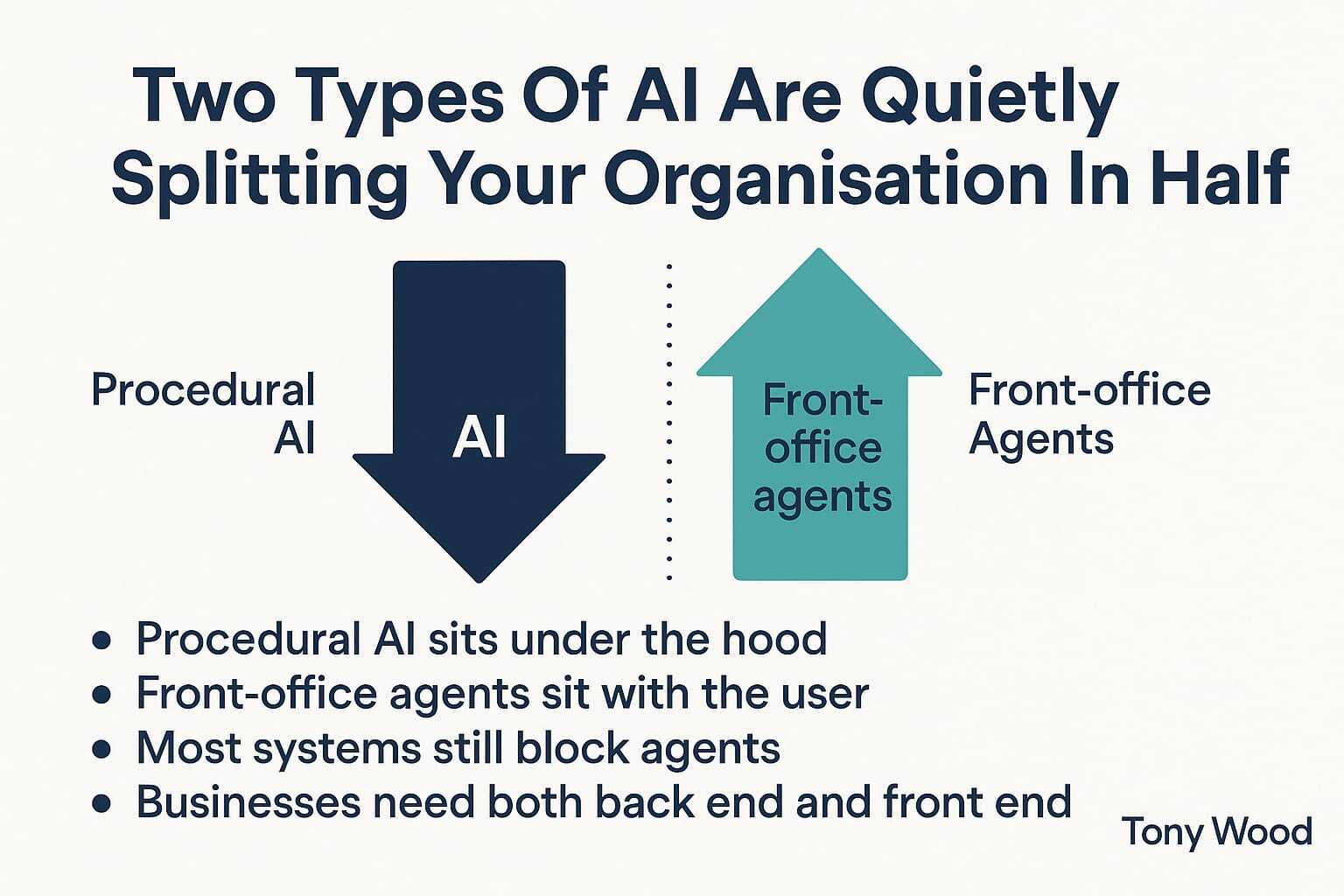
The first type sits under the hood.
Split

These are procedural AIs handling back office tasks. Think data tidying, standardised processes, and deterministic workflows. Sometimes there is a bit of fuzzy logic, but the main job is to support or automate steps in a process.

Most of these systems still rely on having a human in the loop.

Fully autonomous, human on the loop setups are rare. At least until organisations reach a higher level of maturity.

The second type lives in the front office.

Here, agents work alongside people on open floors or at their desks. These agents have access to the user’s systems. Usually running on a laptop or a dedicated machine sitting next to the user. The agent completes actions as if it were the user.

Here’s the thing. The main challenge is that most business systems are not agent friendly.

In fact, many actively block agents from working with them. This creates real problems. If your agent cannot access the system, it cannot do the work. Simple as that.

So, we end up with two areas, two systems that people are using.

I think it is worth businesses taking a hard look at both to see which approach will give them the most value. You cannot simply focus on the back end systems, which are more deterministic. You need to consider both.

  • How are you automating your front-end systems?
  • What about the back end elements?

In my experience, a balanced approach is key.

Ignoring either side means missing out on real opportunities for agentic workflow and low-friction automation.


Agentic (AI created research and content)

This section adds research context to the same core idea: leaders need to treat procedural automation and agentic workflows as different tools, with different risks, controls, and value paths.

What The Market Is Converging On (And Why It Matters)

One useful way to cut through the noise is to separate three concepts that often get bundled together.

Shailen Pandey frames it like this:

"RPA (Robotic Process Automation), AI Agent, Agentic AI - All three are automation technologies but are fundamentally very different and apply very differently.

Great Analogy to understand and compare them -

  1. RPA (akin to a Factory Worker)

Rule-based, repetitive automation.

Example: Copying invoice data between systems.

  1. AI Agents (akin to a Office Assistant)

AI that understands and acts on context.

Example: A support bot that resets your password and opens a ticket.

  1. Agentic AI (akin to a Project Manager)

Autonomous, goal-driven, multi-step planners.

Example: “Reduce logistics cost by 5%” → it analyzes routes, negotiates carriers, and suggests actions.

RPA automates tasks, AI Agents assist with decisions, and Agentic AI drives outcomes.

Leaders who cut through this hype can place the right bets for transformation."

Source: https://www.linkedin.com/posts/shailenpandey_clarity-genai-simple-activity-7363625236887408640-Xnlk

That maps cleanly to what many of us are seeing inside organisations:

  • Back office often suits rule-based and deterministic automation.
  • Front office often needs context, judgement, and flexible planning.
  • Governance needs to change as autonomy increases.

A Practical Distinction Leaders Can Use In Steering Meetings

Manthan Patel puts a sharp point on the difference between automation and agents:

"The bottom line: Automation executes tasks. Agents solve problems.

Both have their place."

Source: https://www.linkedin.com/posts/leadgenmanthan_ai-automation-vs-ai-agent-clearly-explained-activity-7310986513117282306-Vza9

If you take one thing into your next AI steering meeting, make it this:

  • If the work is stable and predictable, optimise for repeatability and controls.
  • If the work is messy and situational, optimise for goal-seeking behaviour, feedback loops, and safe escalation to humans.

Why Back Office Agentic Work Is Rising (And What “Low Risk” Actually Looks Like)

Jerry Liu highlights a pattern that matters for leadership teams. Agents are not only showing up in customer-facing contexts. They are also moving into back office automation, where there is routine work over unstructured documents.

"Backoffice automation is a fantastic use case for agents. A lot of backoffice work depends on routine operations over unstructured documents (invoices, claims packets, loan files). The best interface to automate these operations is enabling users to create deterministic workflows at scale, instead of solving ad-hoc tasks through chat.

To make this work well, agents need to be semi-autonomous but low-risk. Humans can trust that the agents can perform large scale document extraction and processing across various types of backoffice work, but the agent needs to be able to surface sources and alert on low confidence scores so that humans can efficiently review and approve the outputs."

Source: https://www.linkedin.com/posts/jerry-liu-64390071_anthropic-recently-published-a-report-that-activity-7431151610107559936-bYlJ

For leaders, “semi-autonomous but low-risk” is not a slogan. It is an operating model decision.

It usually means:

  • Clear boundaries on what the agent can do without approval.
  • Confidence signals, so people can review the right things.
  • Audit trails, so you can explain decisions later.
  • Escalation paths, so exceptions do not become incidents.

The Leadership Trap: Optimising Only One Side Of The House

If you only modernise the back office, you can end up with:

  • Faster internal processing
  • But no improvement in frontline throughput
  • And a growing gap between how work is done and how systems are governed

If you only chase front office agents, you can end up with:

  • A lot of “demo magic”
  • But brittle access, blocked systems, and inconsistent outcomes
  • And a compliance team that never signed up for the risk profile

The balanced move is to build a portfolio.

  • Procedural automation where work is stable.
  • Agentic workflow where work is variable and value is in judgement.
  • Human-in-the-loop controls where risk is high.
  • Human-on-the-loop oversight where the organisation is mature enough to manage it.

A Simple Leadership Checklist For The Next 30 Days

Use this to facilitate evidence-based decision making, without getting dragged into technical detail.

  • Map your work
  • Which processes are deterministic?
  • Which processes are judgement-heavy and exception-driven?
  • Map your systems
  • Which systems are agent friendly in practice?
  • Where do authentication and permissions block progress?
  • Pick one pilot per category
  • One procedural back office pilot focused on cycle time and error rate.
  • One front office agent pilot focused on throughput and user experience.
  • Set governance early
  • Define what “approved action” means.
  • Define what requires a human review.
  • Define what must never be automated.
  • Measure what matters
  • Time saved is useful, but also measure rework, exceptions, and trust.
  • If people do not trust it, they will route around it.

Closing Thought

This stuff is genuinely hard.

The organisations that win will not be the ones with the loudest AI story. They will be the ones that can hold two truths at once:

  • Deterministic automation still matters.
  • Agentic workflows change how work gets done, and they demand a different level of design, access, and governance.

Links

Quotes

  • "RPA, AI Agent, Agentic AI - All three are automation technologies but are fundamentally very different and apply very differently.\n\nGreat Analogy to understand and compare them -\n1. RPA (akin to a Factory Worker)\nRule-based, repetitive automation.\nExample: Copying invoice data between systems.\n\n2. AI Agents (akin to a Office Assistant)\nAI that understands and acts on context.\nExample: A support bot that resets your password and opens a ticket.\n\n3. Agentic AI (akin to a Project Manager)\nAutonomous, goal-driven, multi-step planners.\n Example: “Reduce logistics cost by 5%” → it analyzes routes, negotiates carriers, and suggests actions.\nRPA automates tasks, AI Agents assist with decisions, and Agentic AI drives outcomes.\n\nLeaders who cut through this hype can place the right bets for transformation."

https://www.linkedin.com/posts/shailenpandey_clarity-genai-simple-activity-7363625236887408640-Xnlk

  • "The bottom line: Automation executes tasks. Agents solve problems.\n\nBoth have their place."

https://www.linkedin.com/posts/leadgenmanthan_ai-automation-vs-ai-agent-clearly-explained-activity-7310986513117282306-Vza9

  • "Backoffice automation is a fantastic use case for agents. A lot of backoffice work depends on routine operations over unstructured documents (invoices, claims packets, loan files). The best interface to automate these operations is enabling users to create deterministic workflows at scale, instead of solving ad-hoc tasks through chat.\n\nTo make this work well, agents need to be semi-autonomous but low-risk. Humans can trust that the agents can perform large scale document extraction and processing across various types of backoffice work, but the agent needs to be able to surface sources and alert on low confidence scores so that humans can efficiently review and approve the outputs."

https://www.linkedin.com/posts/jerry-liu-64390071_anthropic-recently-published-a-report-that-activity-7431151610107559936-bYlJ

Share this post