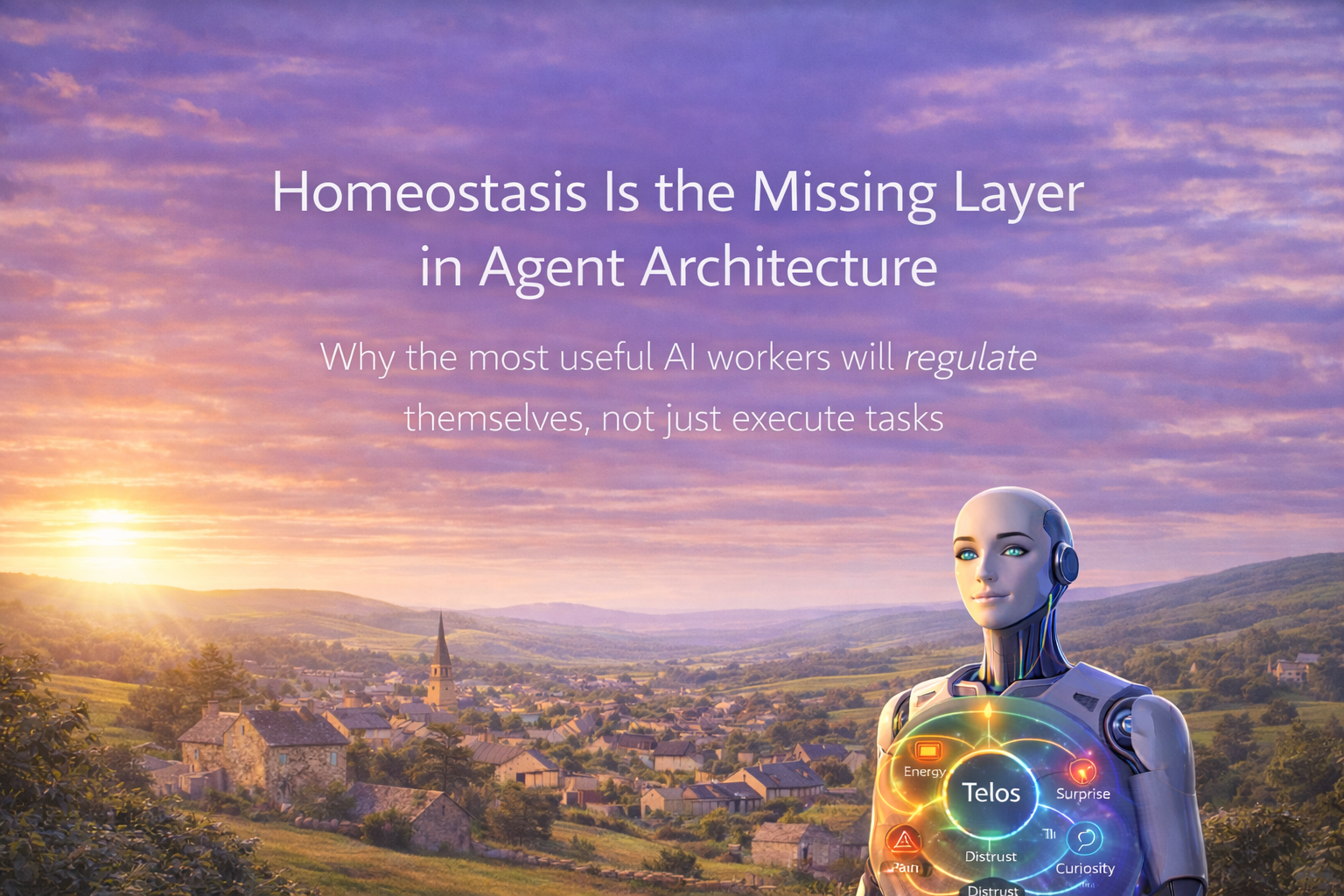

Why the most useful AI workers will regulate themselves, not just execute tasks
Date: 6 March 2026
Most agent systems today are built around four things.
• goals
• plans
• tools
• outputs
That is enough to make them impressive.
But it is not enough to make them dependable.
The weakness of current agents is not intelligence.
It is the absence of self-regulation.
Agents can continue when they should stop.
They can sound confident when the evidence is weak.
They can optimise locally while quietly damaging trust globally.
They can act.
But they do not yet know how to hold themselves together while acting.
That missing capability is what biology solved long ago through homeostasis.
From Task Engines to Self-Regulating Workers
Most agents operate through a simple loop.
Goal → Plan → Act → Repeat.
This loop is powerful.
It allows agents to execute workflows, call tools, and produce outputs.
But it ignores something fundamental.
Biological intelligence never operates in a pure execution loop.
It constantly monitors its own condition while acting.
A homeostatic architecture adds that missing layer.
Instead of asking only:
“What should I do next?”
The system also asks:
• What condition am I in?
• What is the risk of acting now?
• Do I understand enough to proceed?
• Should I continue, slow down, or stop?
When that layer exists, the architecture changes.
Goal + Internal State + Environment → Decide → Act → Update State → Reflect → Repeat
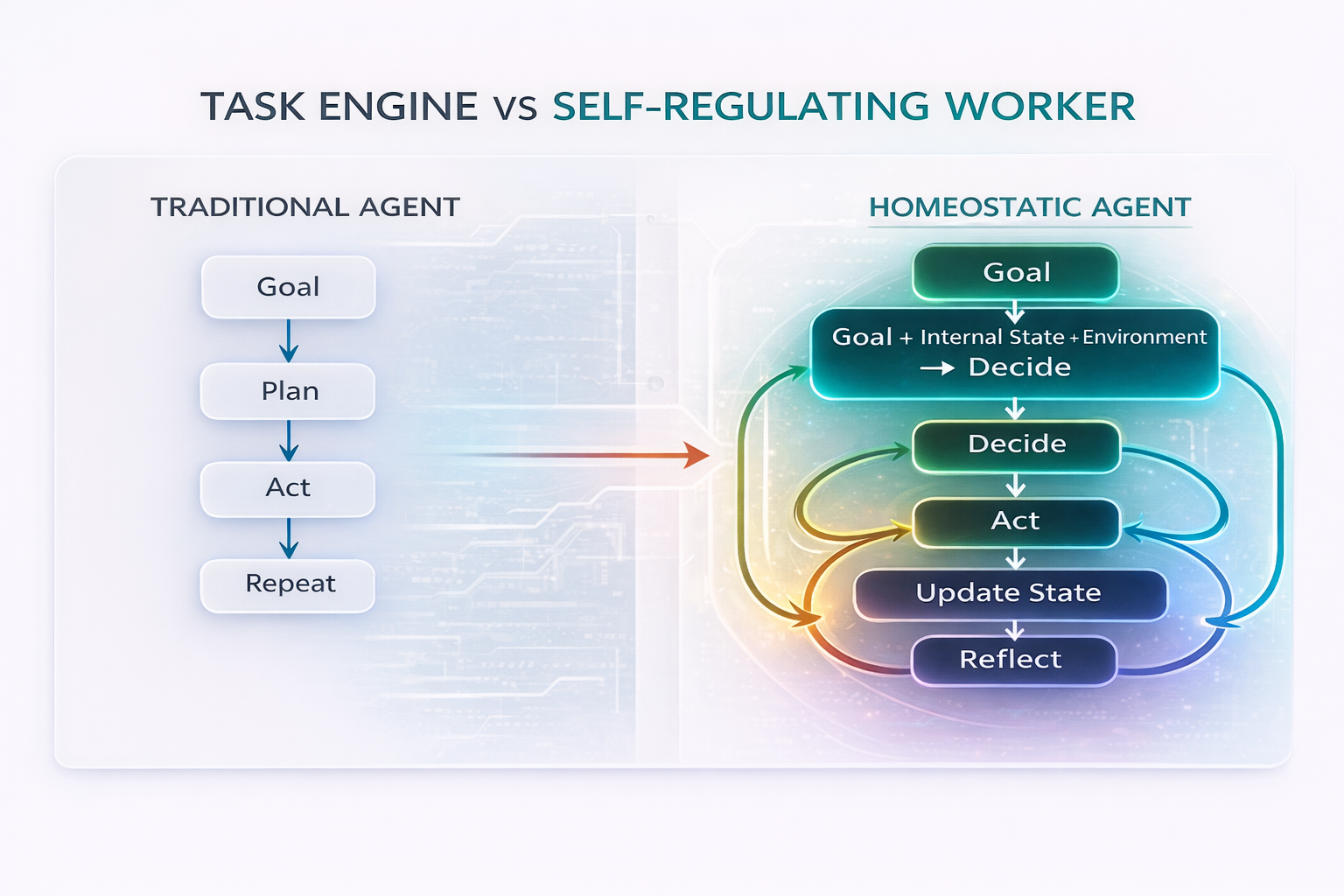
That small structural change transforms an agent from a task engine into a long-lived worker.
Why This Matters Commercially
If agents are going to operate inside real organisations, capability alone is not enough.
Businesses need systems that are:
• predictable
• controllable
• trustworthy
• durable
Homeostatic agents improve all four.
They produce:
• fewer preventable mistakes
• fewer badly timed actions
• clearer approval paths
• lower supervision overhead
• more stable behaviour over time
This is where the real economic value lies.
Not in making agents more entertaining.
But in making them safe enough to deploy at scale.
Internal Regulation Signals
Homeostasis does not mean pretending machines have emotions.
It means giving them internal signals that regulate behaviour.
In OpenClaw, the system operates using a small set of control signals.
• Energy – effort and computational strain
• Pain – damage, incident, or risk signals
• Surprise – mismatch between expectation and reality
• Distrust – tightening permissions when reliability drops
• Curiosity – exploration pressure in safe contexts
• Shame – repair pressure after violating internal standards
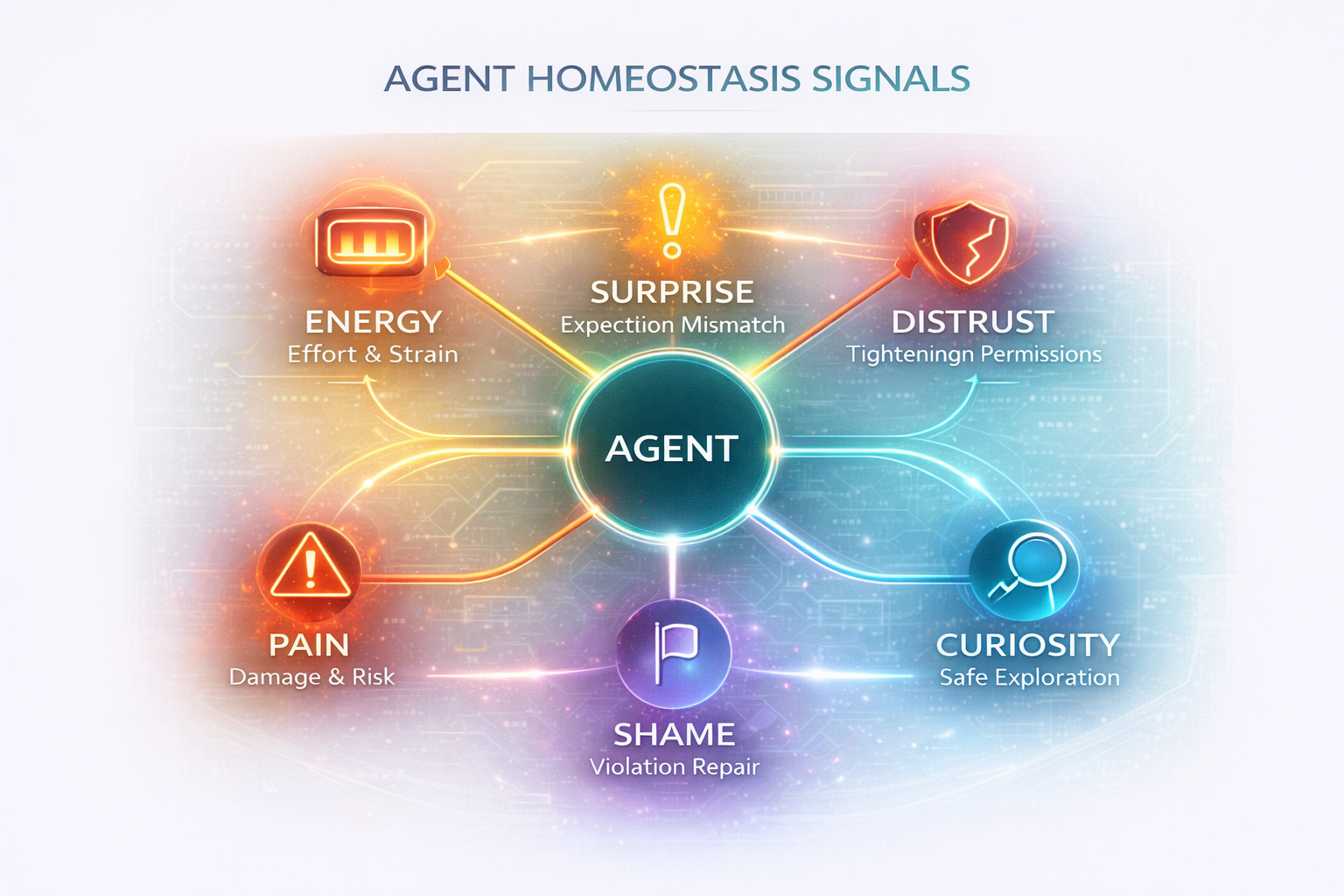
These signals are not decorative.
They shape posture.
Energy prevents burnout.
Pain prevents silent failure.
Surprise slows reasoning when models break.
Distrust reduces autonomy when reliability drops.
Curiosity drives exploration.
Shame drives correction.
Together they prevent agents from behaving like optimisation engines with no brakes.
Mood and Personality as Operating Layers
Many AI systems treat mood and personality as cosmetic features.
In serious agent systems, they should be operational layers.
Mood is the fast layer.
It answers questions like:
• Is something wrong here?
• Should we be cautious?
• Is this routine execution or an exception path?
Personality is slower.
It represents continuity across time.
It stores what the system has learned, what it values, and what kind of worker it is trying to remain.
Put simply:
Mood helps the system respond.
Personality helps the system remain itself.
This becomes critical when agents operate over long periods alongside humans.
Telos: The Centre That Holds the System Together
Signals alone are not enough.
A system also needs a centre of orientation.
In biology that centre is survival.
In organisations it is purpose.
In agentic systems this centre can be understood through the concept of Telos.
Telos is an ancient philosophical idea from Aristotle.
It refers to the end or purpose toward which a system naturally aims.
Without a telos, signals exist but direction does not.
Pain may warn.
Curiosity may explore.
Distrust may restrict.
But none of these answer the deeper question:
What is this system trying to remain?
Telos provides that anchor.
In OpenClaw, Telos is operationalised through five checks.
• self-integrity
• other-impact
• alignment with purpose
• boundary health
• uncertainty / model fit
These transform philosophical purpose into practical questions.
• Am I stable enough to act well?
• Could this harm trust or people?
• Is this aligned with the system’s purpose?
• Do I have the correct permissions?
• Do I understand enough to act?
Telos prevents the system from improvising purely from mood or optimisation pressure.
It gives the architecture a stable centre of gravity.
Head | Heart | Gut | Spine
A useful way to operationalise these checks is through four reasoning lanes.
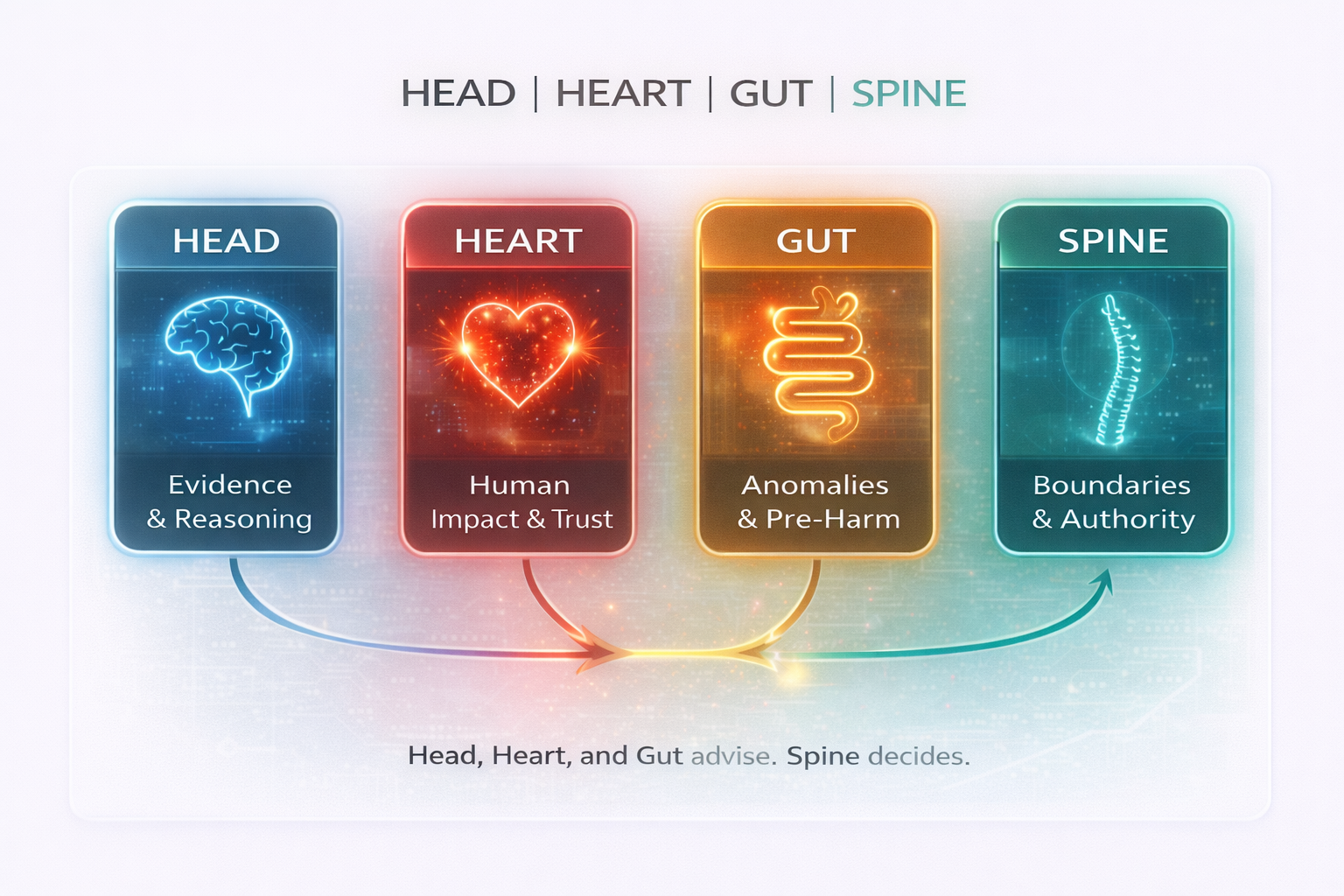
Head
Evidence and critical reasoning
Heart
Human impact and trust
Gut
Anomaly detection and pre-harm sensing
Spine
Boundaries and execution authority
Head, Heart, and Gut advise.
Spine decides.
This structure mirrors how strong teams operate.
Evidence may support an action.
Human impact may warn against it.
Anomalies may suggest hidden risk.
Ultimately, the system must decide whether it is permitted to proceed.
Spine provides that authority.
Without it, intelligence easily turns into overreach.
Legibility and Human Trust
People do not simply want answers.
They want working relationships.
Trust grows when behaviour is legible.
You trust a colleague more when you understand:
• how they reason
• what they care about
• what concerns them
• where they draw boundaries
The same principle applies to agentic systems.
If an agent can explain decisions in terms of evidence, impact, anomalies, and boundaries, humans can:
• challenge it
• supervise it
• collaborate with it
The agent becomes a participant in the workflow rather than a black box.
The Role of Sleep
If homeostasis is the missing layer, sleep is one of its most important mechanisms.
Systems that never pause eventually become:
• noisy
• brittle
• self-contradictory
OpenClaw separates two modes.
Waking mode
• real inputs
• real consequences
• constrained execution
Dreaming mode
• simulation
• reflection
• hypothesis generation
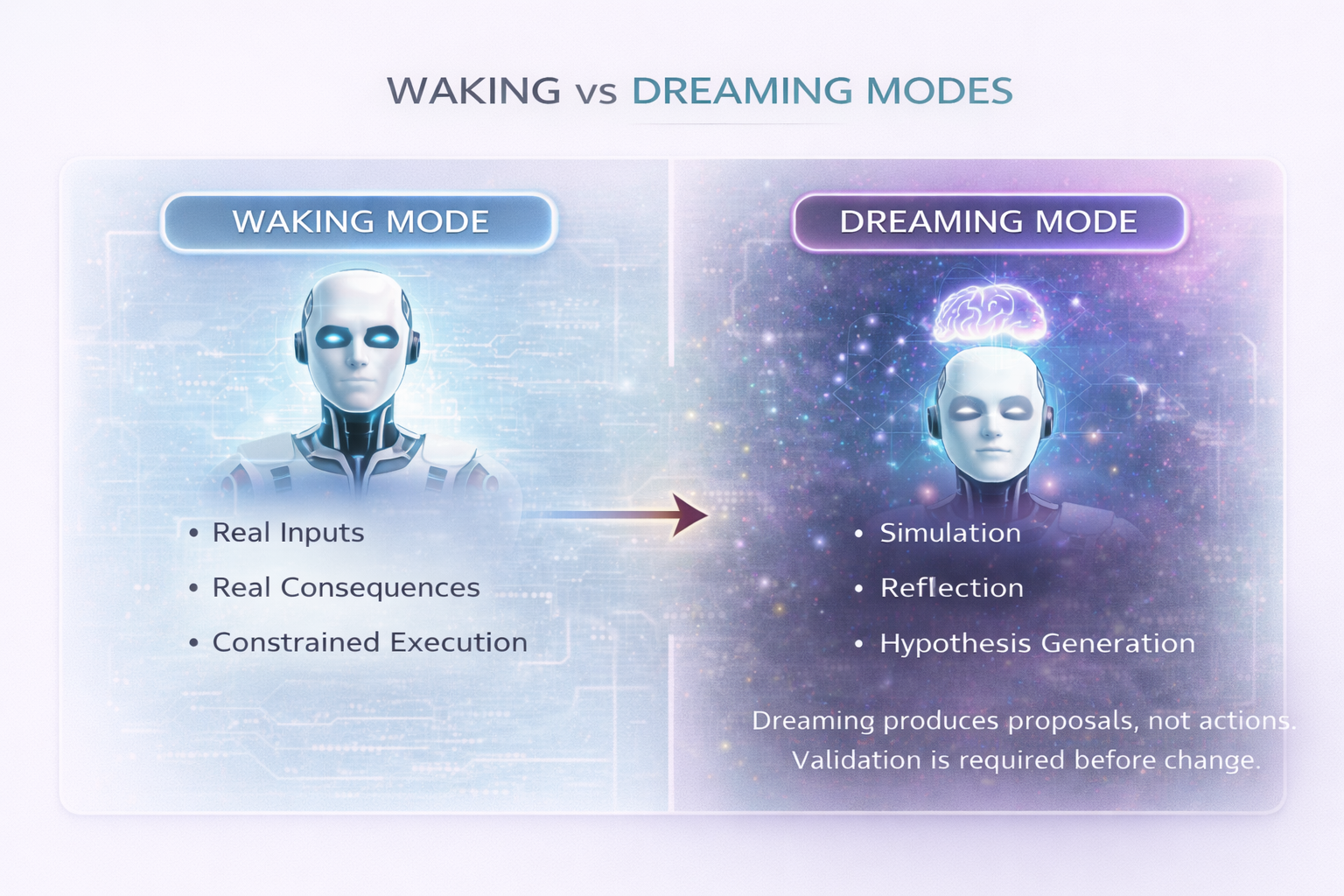
Dreaming mode allows the system to:
• replay events
• identify patterns
• generate improvement proposals
• consolidate knowledge
Crucially:
Dreaming produces proposals, not actions.
Every proposal must pass through waking-mode validation before affecting the world.
This separation protects systems from acting on speculation or hallucination.
The Homeostasis Loop
Once these elements exist, the system forms a continuous cycle.
Signals influence posture.
Posture shapes decisions.
Decisions create outcomes.
Outcomes trigger reflection.
Reflection improves the system.
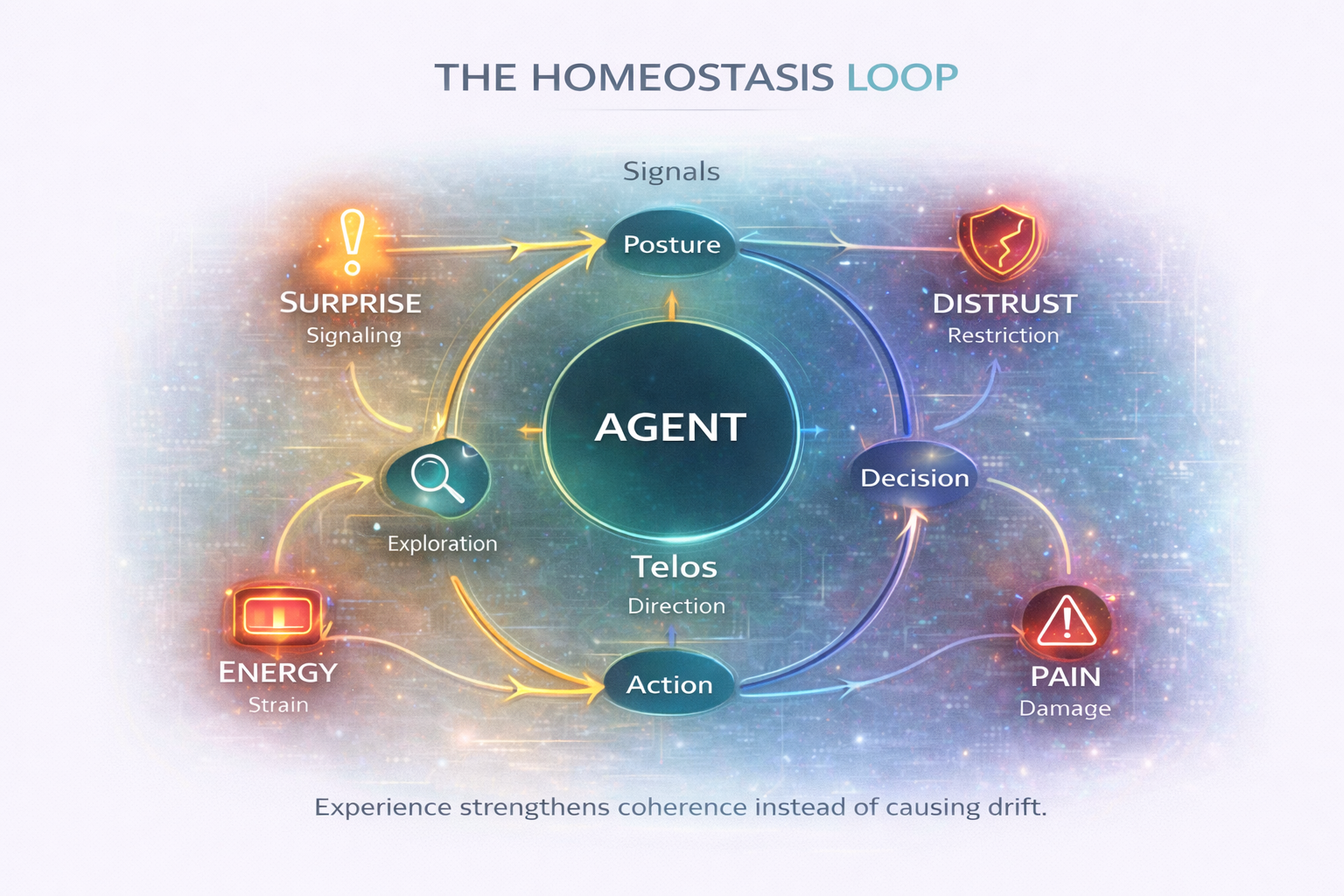
Over time the system becomes more stable, not less.
Experience strengthens coherence instead of causing drift.
The Agent Nervous System
One helpful way to visualise this architecture is as a layered nervous system.
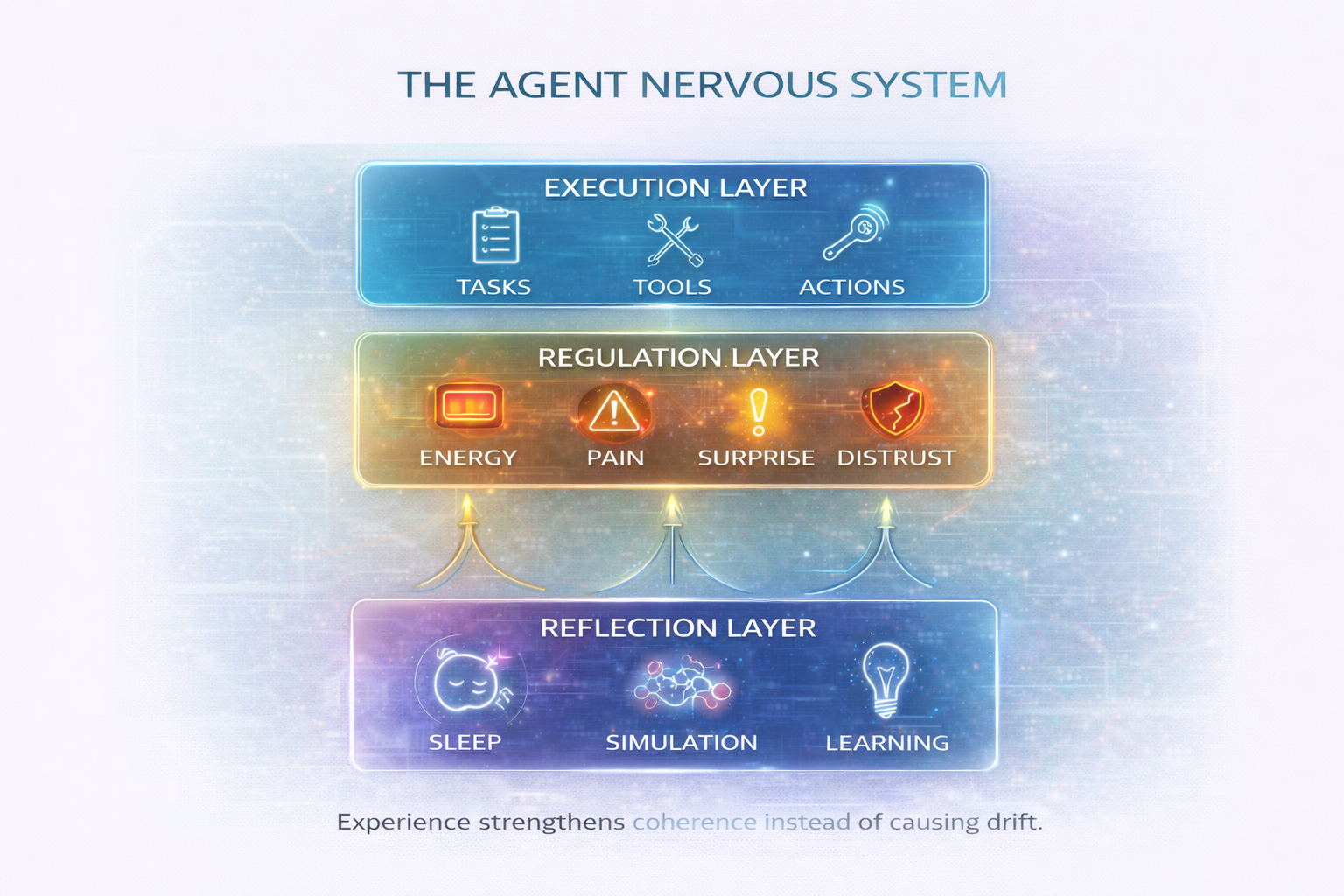
Execution layer
Tasks, tools, actions
Regulation layer
Energy, pain, surprise, distrust
Reflection layer
Sleep, simulation, learning
These layers allow the system to:
act, regulate, and evolve.
What Early Implementations Suggest
Initial experiments suggest several patterns.
First.
Emotionally legible governance works better than cosmetic personality tuning.
Signals such as surprise, distrust, and pain improve behaviour without needing to control execution directly.
Second.
The Head | Heart | Gut | Spine model clarifies both machine reasoning and human disagreement.
Third.
Spine is more important than many teams expect.
It prevents agents from talking themselves into dangerous actions simply because the idea sounds efficient.
Fourth.
Sleep cycles create real value.
They allow learning without allowing uncontrolled self-mutation during live operations.
Finally.
Humans appear more comfortable working with systems that can explain why they are cautious, not just what they believe.
A Useful Way to Think About It
Traditional agent model
• do the task
• use the tools
• optimise the result
Homeostatic agent model
• do the task
• monitor internal state
• detect strain and anomaly
• regulate autonomy
• separate reflection from execution
• maintain a stable centre
• learn through reviewable cycles
This is a far stronger foundation for real deployment.
Where This Leads
The future of agent systems is not just better planning.
It is better self-regulation.
The most successful systems will not be the ones that appear the smartest in demonstrations.
They will be the ones that can:
• work longer
• fail more safely
• communicate clearly
• learn without drifting
• integrate into real teams
Homeostasis turns an agent from a clever tool into a dependable worker.
Once that happens, the economics change.
You are no longer buying isolated outputs.
You are building a workforce that can hold itself together.