AI
Agentic
Agentic Strategy


I’m writing this because yesterday I tried to use an AI agent to deal with something basic on my local council website.
I live in North London. Like most places, the council has a website. I thought: I have an agent, why not automate a few tasks?
I wanted simple things.
I set the agent up, got it running, and sent it off to do the job.
It hit a wall almost immediately.
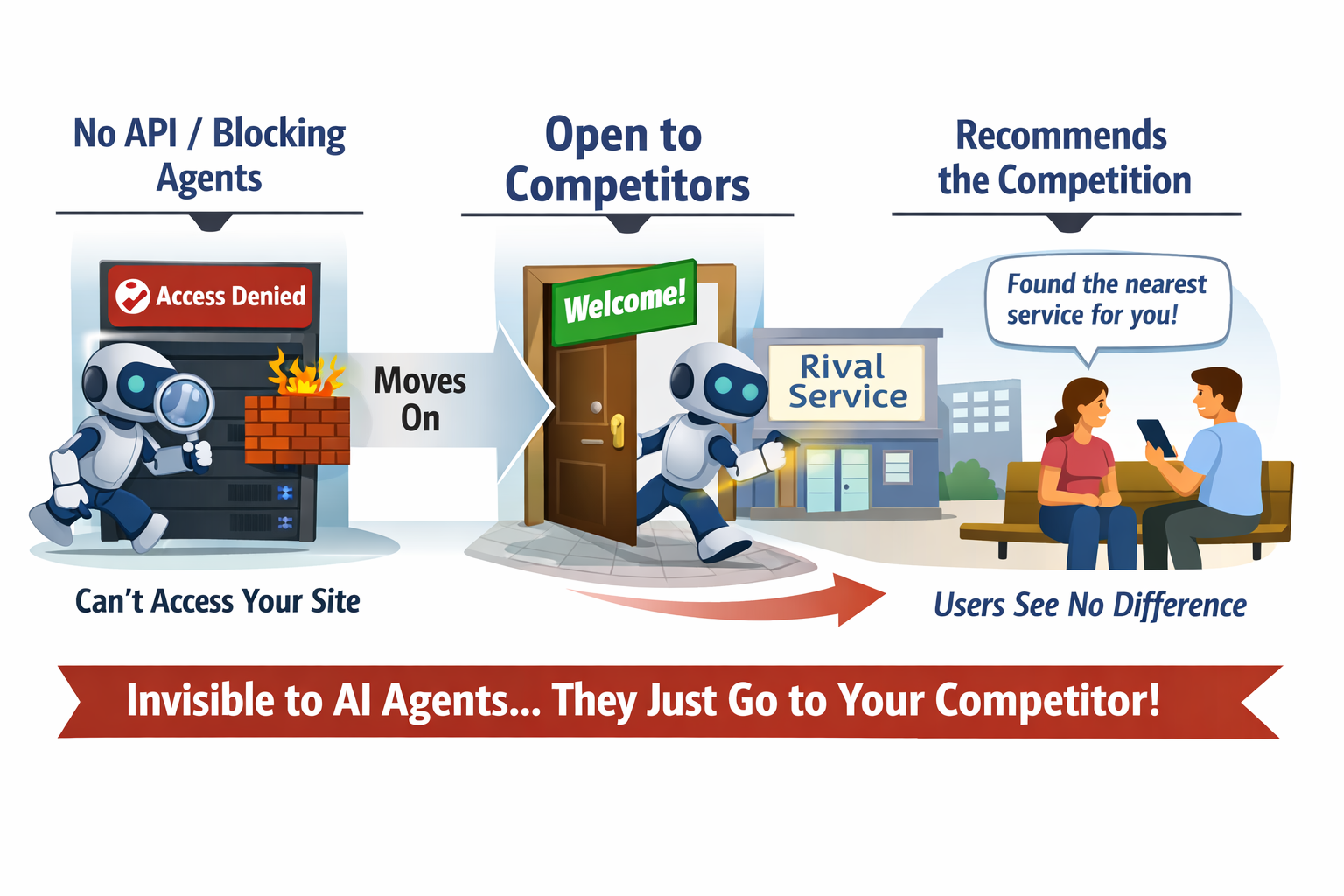
The council’s systems detected the agent, saw it was running on a virtual private server, and flagged it as spam.
Then I realised the bigger issue.
My council has no API (Application Programming Interface). So it’s invisible to every single agent in the world.
Not only invisible. It’s actively blocking them.
Here’s the thing. If I want the information, I have to do it myself, with my browser and my own eyes.
Yes, I could run an agent inside my own browser and hand over my login details. But that feels risky, and I’m not comfortable with it.
That led to a bigger question.
If the next wave of development is agents talking to services, and you don’t have an API layer, you’re invisible.
You can’t be seen.
You’re not at the table.
You’re not even in the room.
So what happens when your clients and suppliers start working through agents as normal?
If your services are invisible to agents, clients won’t find you.
They won’t go to your website, because your website is built for humans.
So where is your data?
Is your API available and accessible?
My suspicion is that most organisations do not have an API strategy for agent access. And they probably do not have a plan to make one public by 2026.
Some might be thinking about it.
I doubt many are taking action.
You don’t want to wait until clients stop working with you because you’re invisible to their agents.
My advice is simple.
Don’t wait until the orders dry up.
By then, it’s too late.
Good luck, everyone.
Agentic workflows are shifting how work gets discovered, evaluated, and executed, and APIs are becoming the “front door” for that future.
Two things can be true at once:
So the leadership question is not “Do we build an API?”
It’s:
There’s a growing expectation that agents will move from assistant behaviour to execution behaviour.
One LinkedIn post frames it like this:
“If 2025 was about the emergence of AI agents, 2026 will be the year they truly transform the business landscape. We are moving beyond passive "copilots" to active, autonomous Multi-Agent Systems that don’t just assist—they execute.”
Another highlights the competitive angle:
“In 2026, we’re heading into an era where AI agents transact with each other, invisibly. Agent-to-agent (A2A) transactions are not a future problem. They are the new competitive layer.”
This matters because “visibility” stops being a branding issue and becomes an operational one.
If a customer’s agent can:
Then the supplier that supports that flow wins more often, even if their website is worse.
That is not hype. It is basic convenience economics.
The strongest argument for APIs is not “we need modern architecture”.
It’s:
InformationWeek makes the link between API accessibility and agentic automation explicit.
Use it as a conversation starter with your CIO (Chief Information Officer) and COO (Chief Operating Officer).
When I see organisations with no meaningful API layer, it often correlates with:
Agents do not fix that.
Agents amplify it.
If your internal world is messy, agentic workflows make the mess run faster.
This stuff is genuinely hard, especially in older organisations with legacy systems, outsourced platforms, or multiple CRMs (Customer Relationship Management systems).
But it is solvable if you treat it as an operating model change, not a “tech project”.
You do not need to expose everything.
Start with a narrow slice that creates value and builds confidence.
Choose a workflow that is frequent, measurable, and currently painful.
Examples:
Make the outcome clear.
Leadership-level rule: expose the smallest surface that still delivers value.
Aim for:
This is where you streamline risk.
You are not “opening the gates”.
You are building a controlled doorway.
If you want agent access, you need governance that can keep up.
At minimum, agree:
If you do not do this early, you end up with shadow APIs and quiet exceptions.
That is how incidents happen.
Your website still matters.
But agentic workflows need:
A human can “figure it out”.
An agent needs rules it can rely on.
Make it real quickly.
If you already use tools like HubSpot, Airtable, or Xero, you can often prototype the workflow before you touch core systems.
The goal is learning, not perfection.
There is a valid concern that APIs increase exposure.
One LinkedIn article puts it bluntly:
“In the agentic era, your API is not a product — it’s a risk surface. Picture a world where systems no longer “call” each other — they understand each other. Where customer data flows contextually between functions, without explicit integration calls. Where AI agents don’t need to query APIs; they interpret intent.”
https://www.linkedin.com/pulse/api-less-enterprise-why-your-product-architecture-needs-hide-fh5mc
I agree with the warning, even if we debate the end-state.
The practical takeaway for leaders is:
If you lead a function, a product, or a whole organisation, here are next steps you can take this month:
If you do nothing, you are betting that your customers will keep doing manual work forever.
That is not a great bet.
https://www.linkedin.com/pulse/api-less-enterprise-why-your-product-architecture-needs-hide-fh5mc