

A code-first guide to crews, flows, intent, memory, and style, anchored in neuroscience
Introduction: Why a Rosetta Stone
When designing agentic employees, teams often begin with familiar software concepts: roles, tools, tasks, workflows, orchestration. As systems scale, however, something subtle happens. These constructs start to behave less like traditional automation and more like employees: they persist across time, adapt to surprises, remember what worked before, and develop recognisable patterns of behaviour.
What is striking is that, at this point, engineering teams begin to independently reinvent concepts that neuroscience has already named.
This paper does not argue that agentic systems are brains, nor that large language models possess cognition in a human sense. Instead, it makes a narrower and more practical claim: when we design systems capable of persistence, adaptation, and learning, the same architectural separations reliably emerge.
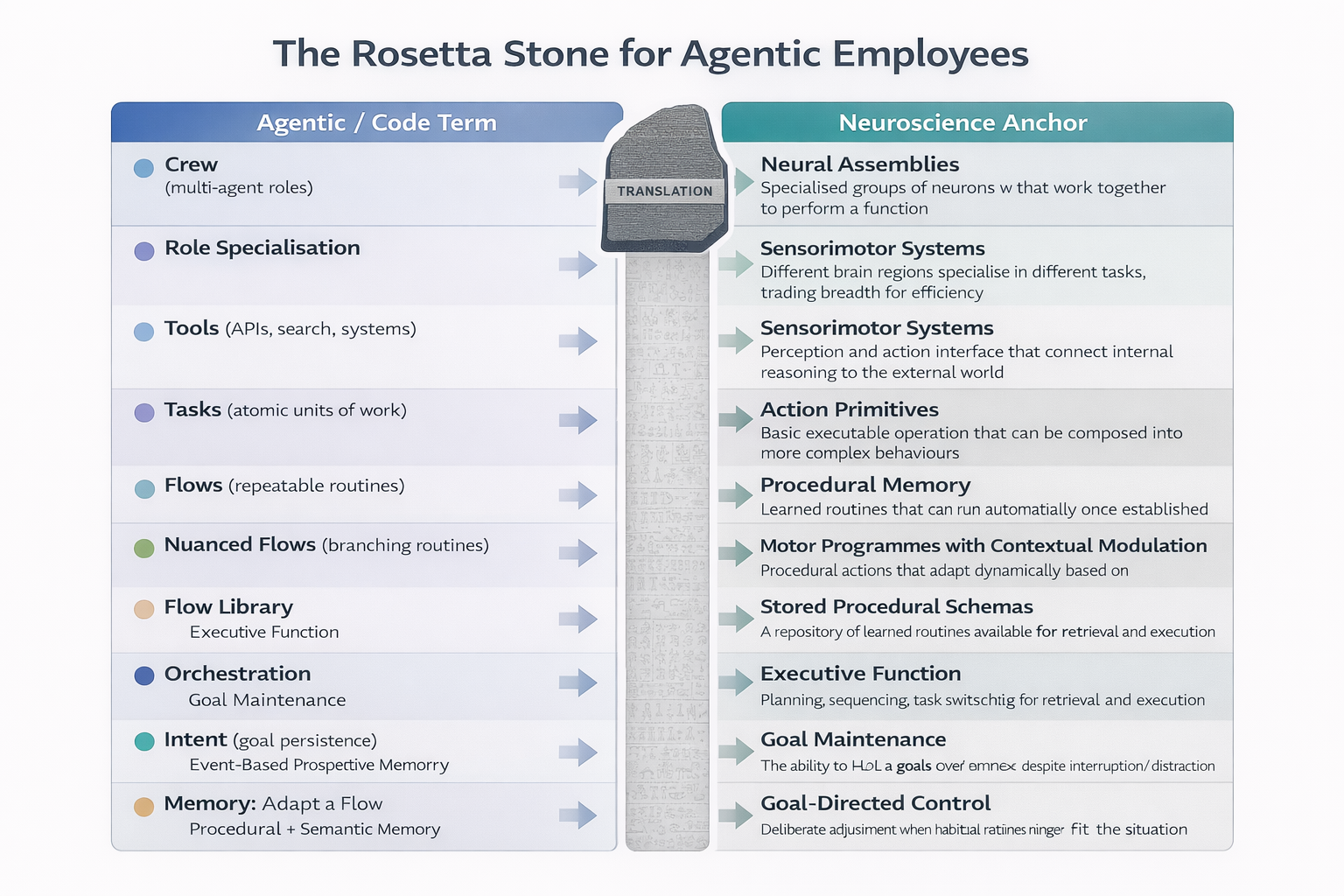
This paper offers a Rosetta Stone. On one side is the language of builders: crews, flows, orchestration, intent, memory, style. On the other is the language of neuroscience. Between them is a translation layer that allows engineers, operators, and leaders to reason about agentic employees using shared mental models without mysticism or hype.
1. Crews: From Roles to Neural Assemblies
In code, we begin with crews.
A crew is a small collection of agents, each with a clearly defined role, working together to complete a unit of work. The simplest useful crew is often two agents: a researcher and a writer. One gathers information. The other synthesises and expresses it. Neither is sufficient alone.
This mirrors a fundamental principle in neuroscience: capability does not live in a single unit, but in coordinated groups. Neural assemblies are collections of neurons that fire together to produce a function. No single neuron “knows” the task. The pattern does.
The implication for agentic employees is important. Intelligence does not scale by making agents bigger. It scales by composition and coordination. Crews should remain narrow, opinionated, and specialised. Complexity belongs in orchestration, not in bloated agents.
2. Tools: Acting on the World
Agents without tools are inert. They can reason, but they cannot act.
In software, tools are APIs, search interfaces, databases, file systems, and messaging layers. They are how an agent touches reality.
In neuroscience, the equivalent is the sensorimotor system: perception and action tightly coupled. Cognition without perception and action is meaningless.
This parallel matters because it reframes tool design. Tools are not accessories. They are the boundary between thought and consequence. Poorly designed tools create blind or clumsy agents. Well-designed tools expand the effective intelligence of the system without changing the model at all.
3. Flows: The Architecture of Routine
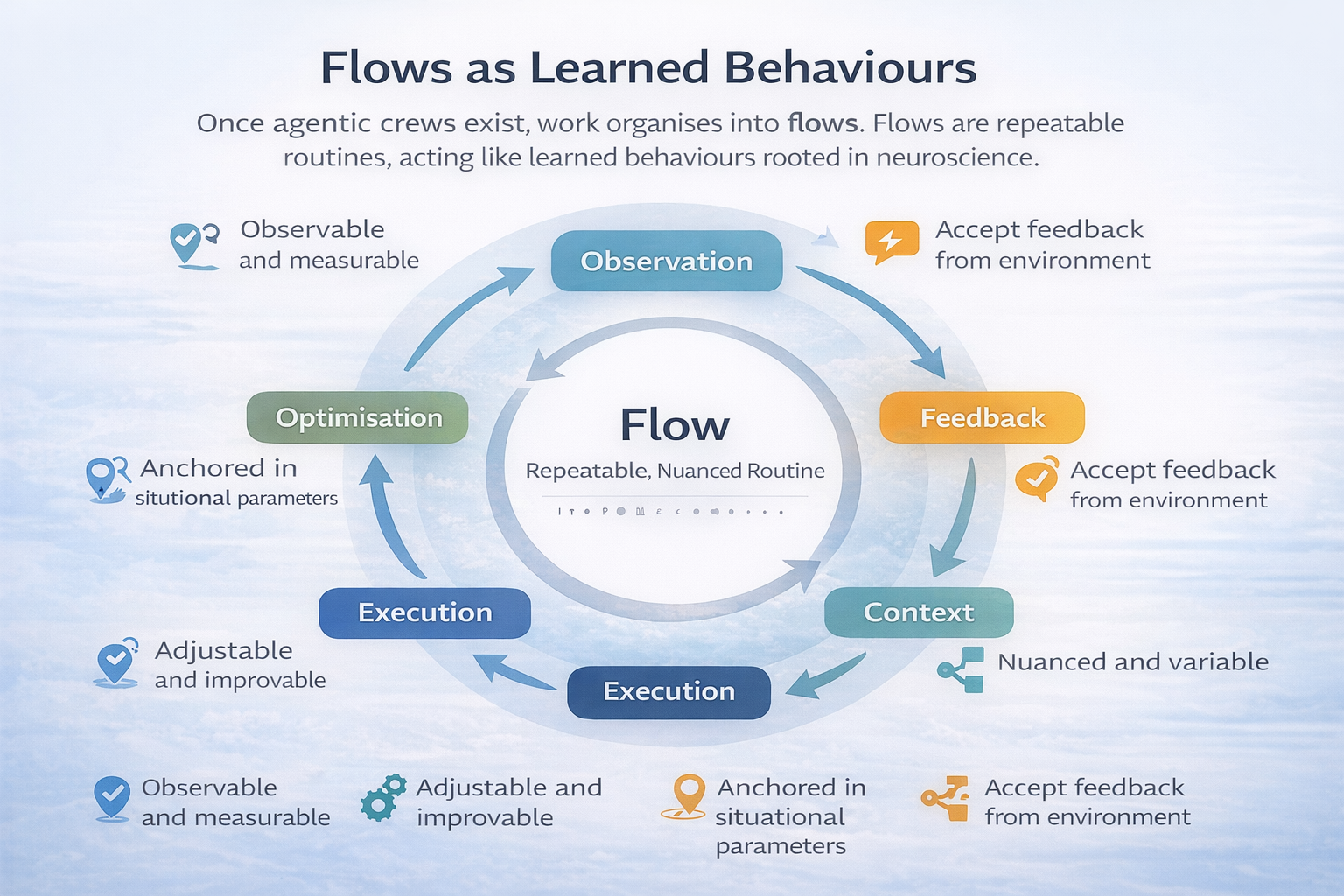
Once crews exist, work quickly organises into flows.
Flows are repeatable routines. Some are rigid and identical each time. Others are nuanced and branching. Brushing your teeth is largely fixed. Walking the dog is repeatable, but full of contextual decisions: traffic, weather, blocked roads.
In neuroscience, this maps cleanly to procedural memory and motor programmes. These are learned routines that execute with minimal oversight once established, yet still accept feedback from the environment.
This framing elevates flows beyond “workflows”. A flow is not just a sequence of steps. It is a learned behaviour. It should be observable, optimisable, and, crucially, interruptible.
4. Orchestration: Executive Function in Code
As flows multiply, something must decide which one runs, when, and why.
This is orchestration.
In code, orchestration resolves contention, sequences work, handles escalation, and enforces boundaries. In neuroscience, this role is played by executive function: planning, prioritisation, inhibition, and task switching.
The key lesson here is organisational, not technical. Orchestration is not glue code. It is where judgement lives. Treating orchestration as an afterthought produces brittle systems that fail under load or surprise.
Agentic employees require explicit orchestration layers that can pause, reroute, escalate, or abandon flows based on changing conditions.
5. Intent: Persistence Beyond Tasks
Flows explain how work is done. Intent explains why work continues.
Intent is the mechanism that allows a goal to persist beyond a single execution. It survives interruption. It reasserts itself when conditions change. It answers questions like: should we continue, reroute, or stop?
In neuroscience, this aligns with goal maintenance and prospective memory. Humans routinely hold intentions that activate later, either in response to events or at specific times.
This is the frontier layer for agentic systems. Without intent, agents are reactive. With intent, they become persistent actors. Intent is what allows a system to notice that a road is closed and decide whether to turn back, reroute, or abandon the walk entirely.
6. Memory as Operating Modes, Not Storage
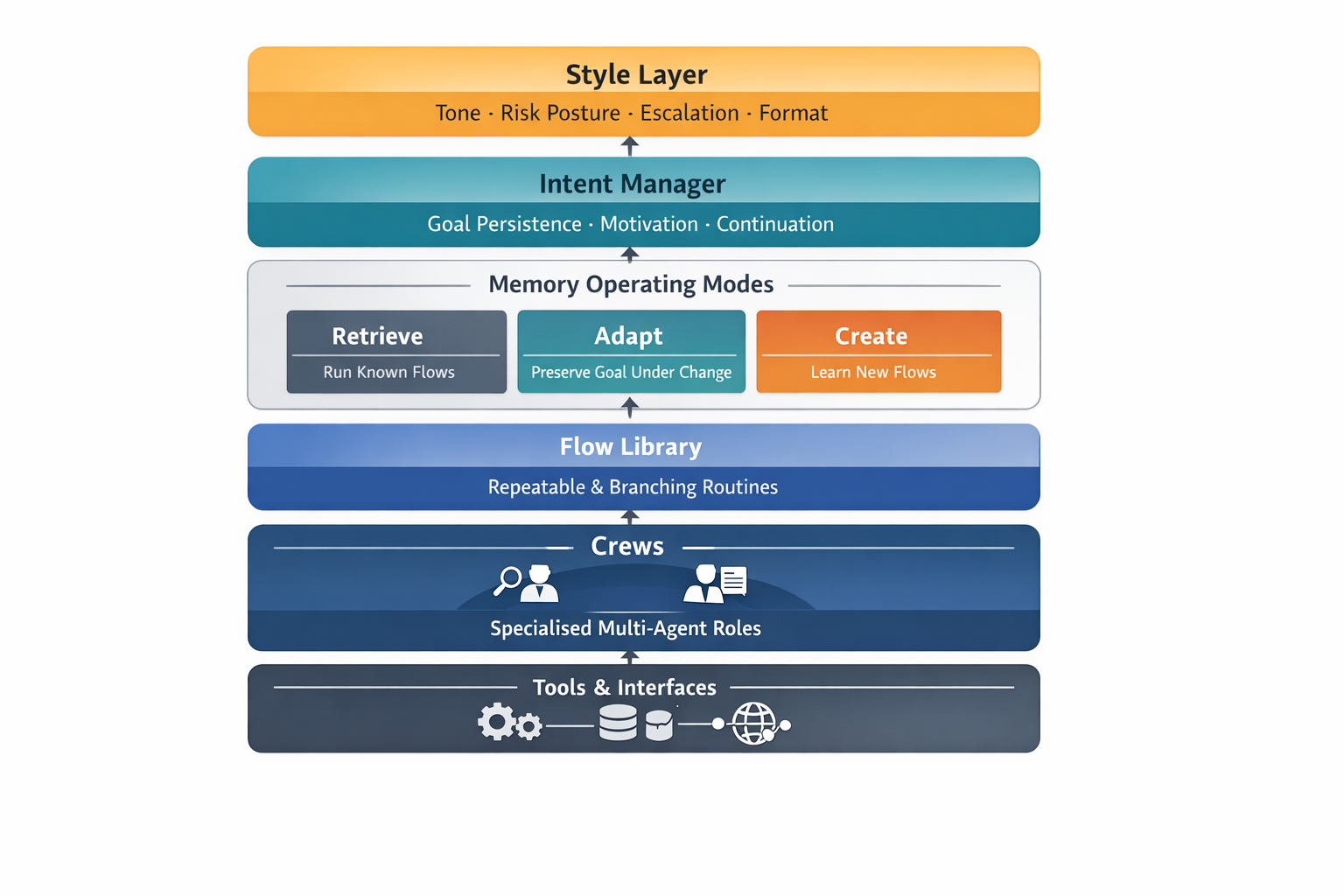
Rather than treating memory as a single store, agentic employees benefit from distinguishing three operating modes.
Retrieve: Running What Is Known
This corresponds to procedural and semantic memory. The system recognises a situation, retrieves the appropriate flow, loads constraints and rules, and executes.
This is the dominant mode in stable environments.
Adapt: Preserving the Goal Under Change
When conditions diverge from expectation, the system shifts into adaptation. The goal remains, but the path changes. This aligns with goal-directed control in neuroscience, where habitual routines give way to deliberation.
Adaptations should be explicit and logged. They are experiments, not rewrites.
Create: Learning New Behaviour
When adaptations repeat and stabilise, the system may create a new flow. This mirrors learning and consolidation. The key design question is not how to learn, but when learning becomes permanent.
This distinction prevents both stagnation and chaos.
7. Temporary vs Permanent Change
Not every deviation should rewrite the system.
In human terms, pain after dental work temporarily alters brushing behaviour. It should not redefine oral hygiene forever.
Agentic employees need the same discipline. Temporary adaptations must remain contextual. Permanent changes require evidence over time. This mirrors schema updating in neuroscience and protects systems from catastrophic forgetting.
8. Style: The Professional Signature
Beyond actions lies style.
Style is not what an agent does, but how it does it: tone, risk posture, escalation thresholds, formatting, boundaries. In humans, we recognise this as personality and behavioural regulation.
In agentic systems, style should be explicit and stable. It belongs above flows, not embedded within them. This separation allows the same capability to express differently across contexts without duplicating logic.
Style is what makes an agent recognisably professional rather than merely functional.
9. Failure Modes and Guardrails
Without guardrails, agentic employees fail in predictable ways: over-adaptation, silent drift, brittle orchestration, or runaway autonomy.
Neuroscience offers a useful reminder: intelligence is constrained as much by inhibition as by action. Logging, escalation rules, human-in-the-loop triggers, and rollback plans are not safety theatre. They are the equivalent of inhibitory control and metacognition.
A system that cannot stop itself is not intelligent. It is dangerous.
Conclusion: A Shared Language for a New Workforce
The value of this Rosetta Stone is not biological mimicry. It is shared understanding.
Engineers gain language to explain design decisions. Leaders gain intuition for why governance matters. Operators gain clarity on where to intervene. None need to become neuroscientists.
Agentic employees are not humans. But when systems persist, adapt, and learn, they inevitably resemble the structures that evolution discovered first.
Understanding that convergence is how we build them responsibly.