
Most companies rely on platforms like LinkedIn or PitchBook to share public profiles and key information.
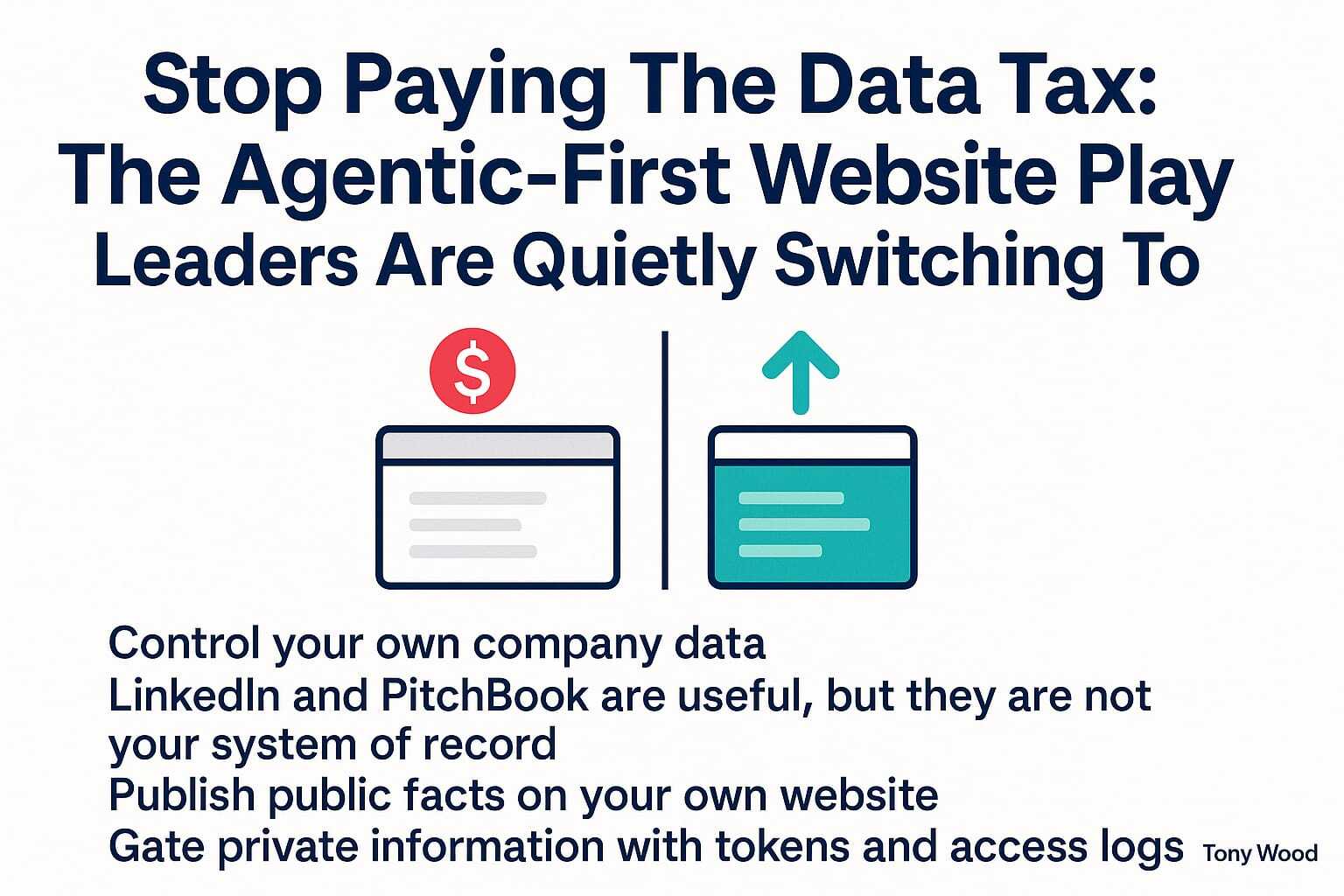
We upload our details, pay for premium listings, and try to stand out, while those platforms control the data and the discovery.
It’s become normal to rent access to our own information.
But why should we pay a tax to share our own story?
Here’s the thing: every time we hand over control, we limit our flexibility and depend on someone else's rules.
When I advise founders or leaders, I see the same pattern.
We spend hours curating company profiles, then hit a wall when we want to automate updates, integrate with new tools, or track who’s using our information.
If you want to innovate or build something agentic, where AI agents can fetch, update, or act on your behalf, you hit friction quickly.
So I keep coming back to a different approach.
What if your website became the primary, agentic source of truth about your company?
Instead of relying on third parties, you could:
- Publish public information on your own site in a simple, machine-readable format, like JSON or structured text
- Keep private or sensitive information behind secure access using tokens, with logging, revocation, and updates in real time
- Place a Machine Control Protocol (MCP) layer on top, so agents know what data is available, what actions are possible, and how to interact safely
This model puts you in the driver’s seat.
You decide what’s public, what’s protected, and who gets access.
You gain evidence-based insight into who’s engaging with your data.
You can iterate on your schema, update workflows, and streamline automation without waiting for a platform update.
To make this work for everyone, the code, schema, and directory should be open source.
That way, the ecosystem grows with you.
Anyone can point an agent at your site and let it discover skills, actions, or updates on demand.
No more filling out the same form in three places or emailing PDFs back and forth.
It’s low-friction automation, based on your terms.
This isn’t about replacing LinkedIn or declaring war on data brokers.
Those platforms have their role, especially for discovery and aggregation.
But leaders deserve an option they own.
An agentic-first website, with open MCP-style access, empowers you to build, streamline, and collaborate without handing over the keys.
Truth is, this stuff is genuinely hard.
It takes a shift in mindset, a bit of technical effort, and a willingness to be open.
But the payoff is agency over your data, your workflows, and your relationships.
If you’re tired of paying rent on your own information, maybe it’s time to try something new.
Start small.
Publish your public data in a structured way, experiment with agent access, and share what you learn.
Community-led innovation starts with one step, and you don’t have to ask permission to take it.
This why I built Agentic First Directory https://www.agentic-first.co/ as an example of how it could work
Agentic (AI created research and content)
Leaders are not asking whether AI exists in the organisation anymore. They are asking whether it can execute safely, repeatedly, and under your governance.
That shift changes what “good” looks like for your company website.
If agents are going to do work on your behalf, your website cannot be a brochure. It needs to be a reliable interface.
A useful way to frame this is that agentic-first is not a feature. It is an operating stance.
As Ed Biden put it: "Agentic-first companies are starting to emerge — and they run as differently from digital-first companies as digital-first did from traditional businesses." (https://www.linkedin.com/posts/edbiden_agentic-first-companies-are-starting-to-emerge-activity-7417890110995619840-Ed5X)
What Changed In 2026 (And Why This Suddenly Matters)
The simplest explanation is that AI is moving from assistance to execution.
Rathan Uday captured the progression clearly: "AI is evolving from simple automation into autonomous systems that can plan, reason, and execute tasks. What we call agentic AI today is the result of a clear progression in how intelligent systems operate." (https://www.linkedin.com/posts/rathanuday_the-rise-of-agentic-systems-ai-is-evolving-activity-7438158217156898816-sm-p)
That progression has a practical consequence.
If your organisation wants an agentic workflow, the agent needs:
- A source of truth it can read without ambiguity
- Clear boundaries for what it can and cannot do
- A way to prove what happened, and when
If your “source of truth” lives inside third-party profiles, you inherit their constraints.
That may be fine for discovery.
It is painful for execution.
The Leadership-Level Risk Most Teams Miss
When your company data sits primarily on third-party platforms, you create a quiet dependency.
Not a dramatic one.
A slow one.
It shows up as:
- Duplicate updates across multiple places
- Confusion over what is current
- Manual checks before anything gets published
- Inability to instrument access and usage on your terms
If you want AI agents to act safely, you need governance that starts at the data layer.
Dr. Dave Goad GAICD signals how quickly governance is becoming central: "Across my client work in financial services, utilities, insurance, and enterprise technology consulting, I have been tracking five strategic trends that I believe will materially shape how organizations build, buy, and govern Agentic AI over the next 18 to 24 months." (https://www.linkedin.com/pulse/5-strategic-trend-shaping-future-agentic-ai-dr-dave-goad-gaicd-horqe)
The Agentic-First Website: A Practical Definition
Based on the validated research context, an agentic-first approach to company data is about making your organisation’s data:
- Publishable from your own domain
- Structured so machines can read it
- Governed so access is explicit and auditable
For broader context on why companies are moving this way now, see:
A Simple Roadmap You Can Run Without Overhauling Everything
You do not need a big-bang rebuild.
You need a sequence that reduces risk as capability increases.
Step 1: Make Your Public Facts Machine-Readable
Pick a small set of public information you already maintain.
For example:
- Company description
- Services
- Locations
- Leadership team
- Hiring links
- Press and announcements
Publish it in a consistent, machine-readable format.
Keep it boring.
Boring scales.
Step 2: Add Controlled Access For Anything Sensitive
Private data should not be “hidden by obscurity”.
It should be protected by design.
Use token-based access so you can:
- Grant access intentionally
- Log access
- Revoke access quickly
- Rotate credentials when needed
This is as much a leadership governance move as it is a technical one.
Step 3: Define The Agent Interface (Before You Let Agents Loose)
This is where an MCP-style layer becomes useful.
Not because it is trendy.
Because it forces clarity:
- What data exists
- What actions are allowed
- What safe interaction looks like
That clarity supports evidence-based decision making.
It also makes vendor conversations easier, because you can specify interfaces, not vibes.
Counterpoints Worth Taking Seriously
This approach is not “free”.
You will feel trade-offs.
- Third-party platforms still win on distribution and discovery
- Your team will need to maintain structure and consistency
- Governance decisions can slow things down if you over-rotate on control
The goal is not to abandon platforms.
It is to stop treating them as the primary system of record.
A Quick Leadership Checklist (Use This In Your Next Ops Meeting)
If you want to pressure-test whether you are paying the data tax, ask:
- Where is our primary company profile maintained today?
- How many places do we update it?
- Who approves changes, and how long does it take?
- Can we tell who consumed our information, and what they used?
- If we introduced an AI agent, what would it read first?
- What would we refuse to let it do, even if it could?
If those answers are fuzzy, you have an opportunity.
Not for a flashy project.
For a low-friction automation upgrade that you can govern.
Closing Thought
A lot of leaders are going to wake up in 12 months with “agentic tooling” and no clean, controlled way for agents to read or act.
You can avoid that trap by making your website the place where truth lives, and where permissions are explicit.
Start small.
Ship one structured page.
Learn what breaks.
Then iterate with your community, your partners, and your future self in mind.
Links
- https://venturebeat.com/data-infrastructure/agentic-first-approach-to-company-data-why-now/ (trust_rating: high)
Quotes
- "Agentic-first companies are starting to emerge — and they run as differently from digital-first companies as digital-first did from traditional businesses." https://www.linkedin.com/posts/edbiden_agentic-first-companies-are-starting-to-emerge-activity-7417890110995619840-Ed5X
- "AI is evolving from simple automation into autonomous systems that can plan, reason, and execute tasks. What we call agentic AI today is the result of a clear progression in how intelligent systems operate." https://www.linkedin.com/posts/rathanuday_the-rise-of-agentic-systems-ai-is-evolving-activity-7438158217156898816-sm-p
- "Across my client work in financial services, utilities, insurance, and enterprise technology consulting, I have been tracking five strategic trends that I believe will materially shape how organizations build, buy, and govern Agentic AI over the next 18 to 24 months." https://www.linkedin.com/pulse/5-strategic-trend-shaping-future-agentic-ai-dr-dave-goad-gaicd-horqe