
I’m writing this because I keep seeing the same pattern. AI projects stall after the minimum viable product (MVP) stage.
The issue is rarely the technical team. They are skilled at building solutions, proofs of concept, and MVPs. The real challenge begins once the prototype is working.
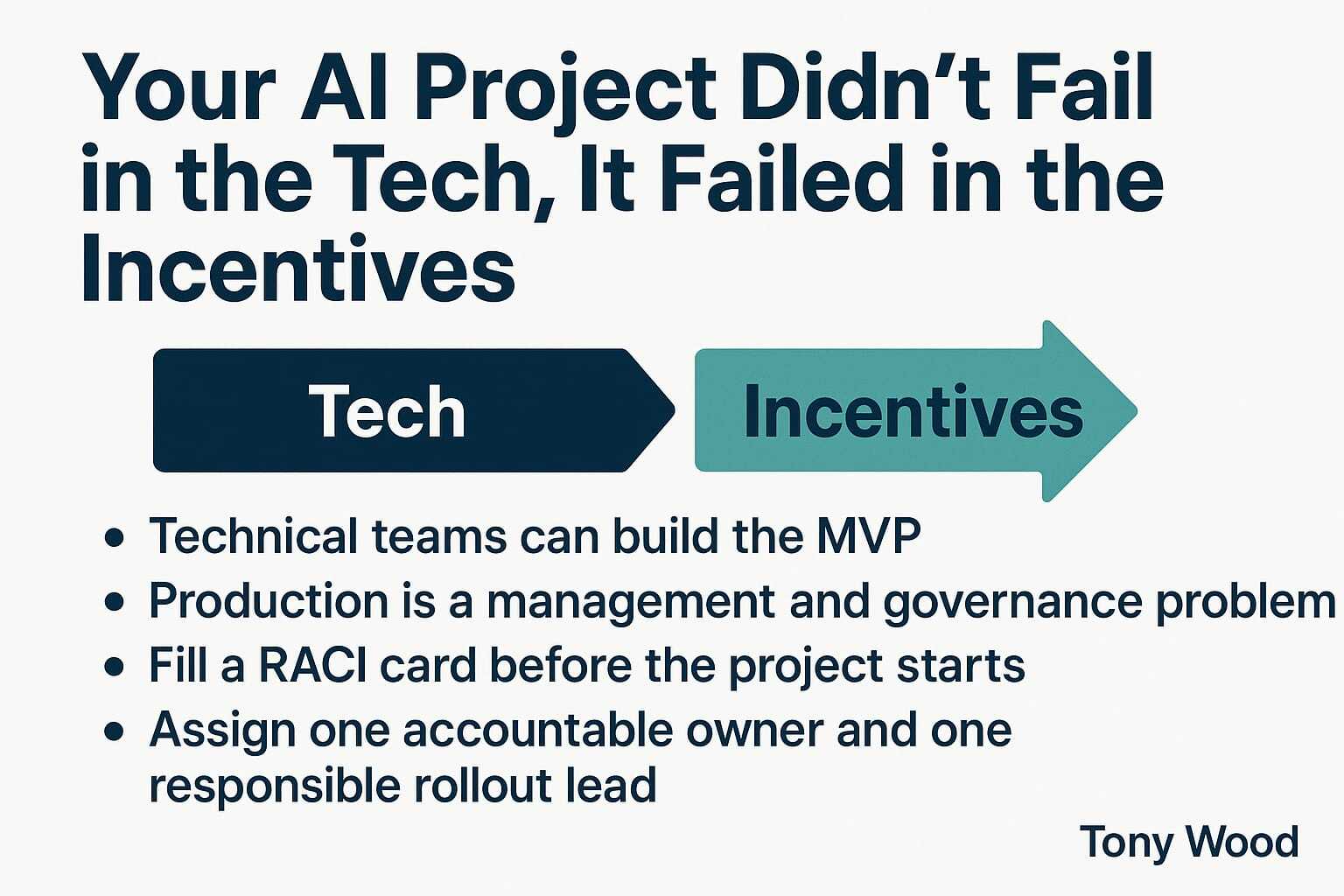
Here’s the thing. Moving from a prototype to a production system is mainly a management and governance problem.
Before starting the project, leaders should fill out a RACI card (Responsible, Accountable, Consulted, Informed):
- Who is accountable if the project does not reach production?
- Who is responsible for ensuring it gets implemented and stays running?
- Who is consulted?
- Who is informed?
Many companies skip this step, and that is often why projects fail to progress. No one is clear on who owns what, or who is pushing the thing over the line.
There’s also an incentive problem. When someone is made responsible for rolling out an AI project, it usually gets added to an already full workload.
The project is supposed to save time, but the person does not get more time, extra people, or a lighter workload. They end up with extra work but no clear incentive to make the project succeed.
So, the problem is not the model or the code. It’s whether the organisation has assigned clear ownership, allocated time, and created incentives for production adoption.
If those aren’t in place, the project stalls, no matter how clever the tech.
If you’re leading an AI project, ask yourself:
- Who actually owns getting this into production?
- Have you written it down?
- Are they supported with time and resources?
- What’s in it for them if it works?
Without clear answers, expect trouble. AI projects don’t fail in the demo. They fail in the rollout. That’s a management problem, not a technical one.
Agentic (AI created research and content)
This is a leadership problem hiding in plain sight, and the evidence in the field keeps pointing to the same root cause: ownership clarity beats technical brilliance when you want production adoption.
What The Field Is Saying (Evidence, Not Opinion)
Multiple practitioners are making the same point in different ways.
Akshit Kush puts it plainly in a RACI-focused post:
“Why the RACI Model Still Wins in Complex Projects
In fast-moving programs, confusion around who owns what is often the biggest risk—not technology.
This visual breaks down the RACI model and shows how teams can use it to bring clarity, accountability, and speed into execution:
✔ Responsible – Who actually does the work
✔ Accountable – Single owner of the outcome
✔ Consulted – Subject-matter experts who guide decisions
✔ Informed – Stakeholders kept in the loop
💡 Why it matters:
Eliminates role ambiguity
Prevents decision bottlenecks
Strengthens ownership and governance
Scales effectively across large, cross-functional teams
I’ve consistently used RACI in enterprise IT, transformation, and delivery programs to align stakeholders and drive predictable outcomes.
Clear roles. Faster decisions. Strong ownership.”
Transform Partner describes the scaling gap as an operational governance vacuum:
“Beyond the Pilot: The RACI Framework for Operational AI
Scaling AI Beyond the Pilot in Regulated Enterprises?
Most initiatives fail at this stage.
The obstacle is rarely the model’s accuracy.
It’s the operational governance vacuum that appears when a data science experiment must become a reliable, compliant, and value-generating product.
Without clear ownership, you face:
• Delivery Delays: from endless debates over who signs off on model performance.
• Audit Nightmares: because documentation and risk controls were an afterthought.
• Value Leakage: where technically brilliant products fail adoption because business alignment was never truly owned.
This is the chasm between a Proof of Concept and a true product.”
Arockia Liborious links this to day-to-day workflow reality:
“The Four Places Enterprise AI Breaks Down
...And Why Most Teams Miss Them
After reviewing dozens of AI initiatives, I’ve noticed something consistent. Enterprise AI rarely fails randomly. It fails in the same four places over and over again.
- Ownership & Workflow Breakdown (The People and Process Gap)
This is the most common failure. The model produces outputs, but
- No one owns the decision
- No workflow actually changes
- We continue working the same way as before AI takes the side seat instead of a decision driver.
If no one is accountable for acting on the output the system will be ignored no matter how good it is.”
Source: https://www.linkedin.com/posts/arockialiborious_ai-farsideofai-activity-7417544893595615234-Met-
The Practical Leadership Reframe
If we accept those points, then the question changes from:
- “How do we build a better model?”
To:
- “How do we build an operating model that makes adoption the default?”
That’s where incentives become the hidden lever.
If you ask someone to “own rollout” but you do not change their capacity, priorities, or recognition, you are not assigning ownership. You are assigning risk.
A Simple RACI-First Rollout Pattern (What To Do Next)
Use this as a leadership checklist before you green-light the next AI MVP.
1) Write The RACI Before You Write The Roadmap
- Name one Accountable person for production adoption.
- Ensure “Accountable” is a single role, not a committee.
- Confirm the Responsible role has time blocked in their week.
2) Make Adoption a Managed Outcome
- Define what “in production” means in your context.
- Define what “used” means, not “deployed”.
- Decide who owns the workflow change, not only the tool.
3) Fix The Incentive Mismatch Early
- Reduce other commitments for the rollout owner.
- Tie success to a visible outcome leaders care about.
- Make it safe to surface risks early, without blame.
Counterpoints Worth Taking Seriously
You can have perfect ownership and still struggle.
- Some use cases are not stable enough for production.
- Some organisations have genuine data quality constraints.
- Some teams are constrained by compliance and audit needs.
The point is not that governance solves everything. The point is that without governance and incentives, you do not even get a fair test.
A Closing Nudge
If your AI work keeps dying after MVP, do not start by asking for another sprint.
Start by asking who owns the result, what changes in their week, and what happens if adoption stalls.
That conversation is uncomfortable. It is also the fastest path to an AI programme that sticks.
Links
- https://www.linkedin.com/posts/akshit-kush-71b563a3_projectmanagement-raci-programmanagement-activity-7425512903786708992-5m8n (trust rating: not provided)
- https://www.linkedin.com/posts/transformpartner_beyond-the-pilot-the-raci-framework-for-activity-7420086519916486656-Upml (trust rating: not provided)
- https://www.linkedin.com/posts/arockialiborious_ai-farsideofai-activity-7417544893595615234-Met- (trust rating: not provided)
Quotes
- “Why the RACI Model Still Wins in Complex Projects
In fast-moving programs, confusion around who owns what is often the biggest risk—not technology.
This visual breaks down the RACI model and shows how teams can use it to bring clarity, accountability, and speed into execution:
✔ Responsible – Who actually does the work
✔ Accountable – Single owner of the outcome
✔ Consulted – Subject-matter experts who guide decisions
✔ Informed – Stakeholders kept in the loop
💡 Why it matters:
Eliminates role ambiguity
Prevents decision bottlenecks
Strengthens ownership and governance
Scales effectively across large, cross-functional teams
I’ve consistently used RACI in enterprise IT, transformation, and delivery programs to align stakeholders and drive predictable outcomes.
Clear roles. Faster decisions. Strong ownership.”
- “Beyond the Pilot: The RACI Framework for Operational AI
Scaling AI Beyond the Pilot in Regulated Enterprises?
Most initiatives fail at this stage.
The obstacle is rarely the model’s accuracy.
It’s the operational governance vacuum that appears when a data science experiment must become a reliable, compliant, and value-generating product.
Without clear ownership, you face:
• Delivery Delays: from endless debates over who signs off on model performance.
• Audit Nightmares: because documentation and risk controls were an afterthought.
• Value Leakage: where technically brilliant products fail adoption because business alignment was never truly owned.
This is the chasm between a Proof of Concept and a true product.”
- “The Four Places Enterprise AI Breaks Down
...And Why Most Teams Miss Them
After reviewing dozens of AI initiatives, I’ve noticed something consistent. Enterprise AI rarely fails randomly. It fails in the same four places over and over again.
- Ownership & Workflow Breakdown (The People and Process Gap)
This is the most common failure. The model produces outputs, but
- No one owns the decision
- No workflow actually changes
- We continue working the same way as before AI takes the side seat instead of a decision driver.
If no one is accountable for acting on the output the system will be ignored no matter how good it is.”
https://www.linkedin.com/posts/arockialiborious_ai-farsideofai-activity-7417544893595615234-Met-