

If you have ever shipped an “always-on” AI agent with a heartbeat, you will recognise the moment the excitement fades and Finance asks a simple question: why is this thing costing more every day, even when nothing is happening?
The Hidden Shift Leaders Miss
Most teams start with capability questions:
- What can it do?
- Can it complete the workflow?
- Does it sound smart?
Then reality arrives, and the questions become operational:
- How often is it “thinking” when it does not need to?
- How much context are we paying to resend each time?
- What is the cheapest way to keep it useful, safe, and consistent?
Here’s the thing. “Always-on” sounds like maturity. In practice, it can also mean:
- Always spending
- Always accumulating context
- Always creating a bigger governance surface area
And that is before you even get to risk, compliance, and data retention.
The Big Reframe: This Is Not “Memory”, It’s Data Management
When leaders talk about agent memory, it often sounds like a human metaphor. Useful, but dangerous if it drives the wrong design decisions.
One line I have been quoting to teams recently is this:
"In reality, agentic AI memory is fundamentally a data management challenge. If we treat it as mere memory, we will be repeating the same mistakes we made with early data lakes—ending up with ‘data swamps’ that are inaccessible, inconsistent, and unusable."
(https://www.linkedin.com/pulse/agentic-ai-memory-its-data-management-pravin-dwiwedi-jpnfe)
That framing changes what you prioritise:
- Not “how do we store everything?”
- But “what do we store, for how long, in what structure, with what retrieval rules?”
This is why “always-on” systems can get expensive fast. They are not only generating tokens. They are also generating data, decisions, and organisational liability.
Why Context Gets Expensive (Even When the Agent Feels Calm)
If you want an agent to behave coherently over time, you typically need it to retain long-term context beyond the model’s immediate context window.
As one practical explanation puts it:
"In agentic AI systems, retaining long-term context (beyond the LLM's limited context window) is essential for maintaining coherent decision history, personalization, and multi-step reasoning across sessions or interactions. A central memory acts as an external "brain" to store, retrieve, and synthesize past data/decisions, preventing loss of history."
(https://www.linkedin.com/pulse/central-memory-agentic-ai-long-term-context-decision-yerramsetti-l6voc)
That is the promise. The cost trap is how teams implement it:
- Shoving yesterday’s entire conversation back into every prompt
- Keeping massive running threads “open” because it feels safer
- Letting agents poll, summarise, and re-summarise without a budget
The system feels “alive”. Your spend graph looks like a staircase.
A Simple Leadership Rule: Pay for Decisions, Not for Noise
When an agent runs continuously, it is easy to confuse activity with value. Leaders need a more disciplined operating model.
Ask these questions in your next steering meeting:
- What decisions do we want the agent to make autonomously?
- What signals trigger those decisions?
- What is the maximum we are willing to pay per decision, per day, per customer, or per case?
If you cannot answer those, you do not have an “AI strategy”. You have a cost leak with good branding.
The “Human Burnout” Analogy That Actually Helps
Humans do not keep every detail of every day in working memory. We survive through routines:
- We externalise tasks into lists
- We use diaries to reduce cognitive load
- We summarise what matters and drop the rest
- We create boundaries, so we can focus
Your agents need the same kind of boundaries, except the boundary is not emotional. It is economic, operational, and risk-based.
This is where design patterns start to matter more than raw model capability.
One good summary of that shift is:
"Agentic AI Design Patterns are emerging as the backbone of real-world, production-grade AI systems, and this is gold from Andrew Ng. Most current LLM applications are linear: prompt → output. But real-world autonomy demands more. It requires agents that can reflect, adapt, plan, and collaborate, over extended tasks and in dynamic environments."
(https://www.linkedin.com/posts/aishwarya-srinivasan_agentic-ai-design-patterns-are-emerging-as-activity-7382092828228673537-1fNP)
Design patterns are not a technical indulgence. They are how you stop paying for “vibes” and start paying for outcomes.
The Practical Playbook: Keep Context, Cut Cost
This is leadership-level, not code-level. You can implement it with your preferred stack, whether that is LangChain, CrewAI, Python, Docker, or n8n. The point is the operating decisions.
1) Create A “Memory Budget” Per Agent
Set a budget like you would for cloud spend:
- Maximum tokens per hour
- Maximum tokens per task
- Maximum number of background cycles per day
Then decide what happens when the budget is hit:
- Degrade gracefully by using summaries only
- Pause non-critical processing until a human trigger
- Switch to a cheaper model for low-risk tasks
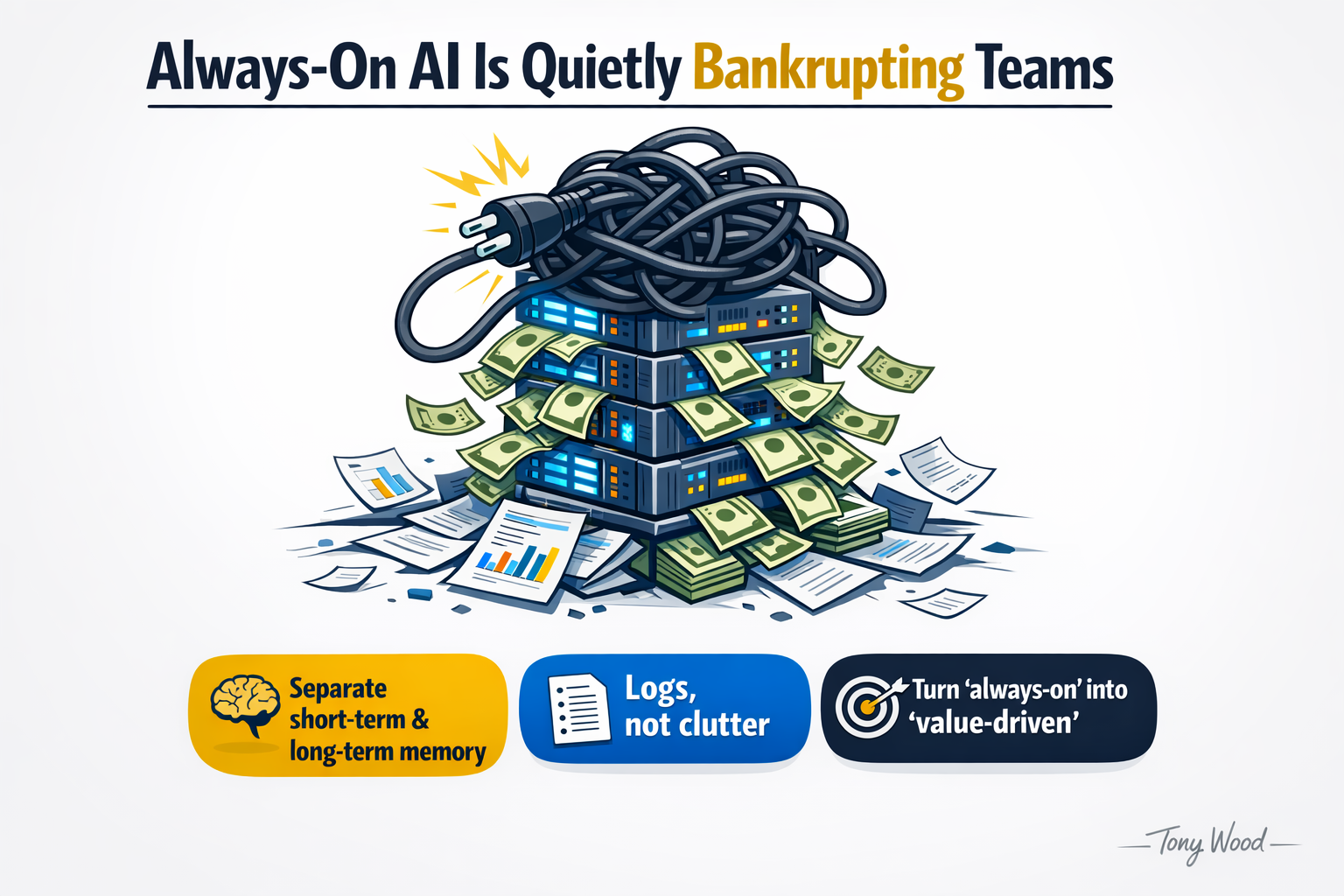
2) Split Memory Into Three Buckets
Do not store “everything” as one blob.
Use three buckets with explicit rules:
- Identity memory: stable facts the agent must not drift on (roles, constraints, preferences)
- Working memory: short-term context for the current task (hours or days)
- Record memory: audited decisions and evidence (for compliance and traceability)
If you are vague here, you will end up with the data swamp problem.
3) Summarise Like A Manager, Not Like A Historian
Summaries should support decisions, not preserve nuance for its own sake.
A good summary contains:
- What was decided
- Why it was decided
- What evidence was used
- What is still unknown
- What to do next and who owns it
4) Make Retrieval a First-Class Governance Choice
The question is not “can the agent retrieve information?”
It is:
- Who is allowed to influence retrieval?
- What sources are permitted?
- What happens when memory conflicts with new instructions?
- How do we prevent accidental leakage between customers, projects, or teams?
5) Treat “Always-On” as a Product Feature That Must Earn Its Keep
Some agents should not be always-on.
Often the best answer is “event-driven”:
- Run when an inbound message arrives
- Run when a threshold is crossed
- Run when a human asks
- Run on a schedule that matches the business cadence, not the engineering excitement
If you want a useful framing on cost trade-offs and context handling, this paper is a good place to start, even if you are not going to read every detail:
- Beyond Persistence: How Managing AI Context Reduces Cost (trust rating: medium)
https://paperswithcode.com/paper/beyond-persistence-how-managing-ai-context-reduces-cost
A Quick Leadership Checklist For Next Week
If you are running pilots or planning production rollout, do this in a single working session:
- Name the top 3 workflows where context actually drives value
- Define the “decision moments” in each workflow
- Set a cost ceiling per decision
- Define memory buckets and retention periods
- Choose a degradation strategy when the budget is hit
- Agree what gets audited, and what gets forgotten on purpose
For most organisations, this is where the savings come from. Not from better prompts. From better boundaries.
Closing Thought: Sustainable Intelligence Beats Perfect Recall
Leaders often assume the best agent is the one that remembers everything. In practice, perfect recall tends to create:
- Higher operating cost
- Higher data risk
- More inconsistent behaviour over time
A sustainable agent is one that remembers what matters, forgets what does not, and can explain the difference.
Quotes
- Pravin Dwiwedi (LinkedIn) (trust rating: medium)
https://www.linkedin.com/pulse/agentic-ai-memory-its-data-management-pravin-dwiwedi-jpnfe
Reason: Reframes agent memory as a data management and governance challenge.
Date written: 2026-02-11 - Ramesh Yerramsetti (LinkedIn) (trust rating: medium)
https://www.linkedin.com/pulse/central-memory-agentic-ai-long-term-context-decision-yerramsetti-l6voc
Reason: Clear explanation of why long-term context matters and how central memory functions.
Date written: 2025-12-29 - Aishwarya Srinivasan (LinkedIn) (trust rating: medium)
https://www.linkedin.com/posts/aishwarya-srinivasan_agentic-ai-design-patterns-are-emerging-as-activity-7382092828228673537-1fNP
Reason: Highlights why agentic design patterns matter for real-world autonomy beyond linear prompt-output flows.
Date written: Not stated