AI
Agentic
Agentic Strategy


If there’s a single habit I’d recommend for anyone building modern AI or so-called agentic systems it's this: resist the urge to leap into complexity. Instead, begin with plain, visible, engineerable foundations. I’ve seen the allure of sophisticated architectures lure teams off the rails. I've also watched the most reliable systems emerge not from heroics, but from patient engineering discipline.
Why this relentless focus? Because as soon as an agentic system leaves the theoretical and hits reality, you must know exactly when it starts, how it behaves, and crucially, whether it's actually working (not ‘sort-of’ working). If you miss this step, every further addition becomes guesswork atop shifting sand.
When I think of system health, I return to a stubborn but simple question: How do you know it works? If your answer involves faith, luck, or frantic Slack threads, you've got a problem.
Yina Arenas summarises this beautifully:
> "Agent observability empowers teams to: Detect and resolve issues early in development. Verify that agents uphold standards of quality, safety, and compliance. Optimize performance and user experience in production. Maintain trust and accountability in AI systems."
> Yina Arenas, Microsoft Azure Blog
Observability, put simply, is your ability to see what’s happening, all the way through. It’s not a checklist ticked after the fact, but the underpinning of reliability, safety, and confidence. Without robust, real-time monitoring, even a clever system becomes a black box—and black boxes inevitably break trust.
For those interested in the practicalities of logging and monitoring in production, “How to Monitor and Maintain AI Models in Production” offers a hands-on guide:
https://medium.com/techsutra/how-to-monitor-and-maintain-ai-models-in-production-97123e1abce9
There’s a reason so many of my projects start in the smallest possible configuration. When building an agentic platform, I’ll often:
This is not a slow, old-fashioned approach but the absolute opposite. As outlined in Microsoft’s Agent Factory best practices, iteration and verification are how we tame complexity:
> "Automated evaluations should be part of your CI/CD pipeline so every code change is tested for quality and safety before release. This approach helps teams catch regressions early and can help ensure agents remain reliable as they evolve."
> Yina Arenas, Microsoft Azure Blog
Think of it as preventative medicine for your entire agentic system. Each step of growth adding new agents, connecting modules, scaling up should be met with fresh, automated checks and quick feedback loops. Never let issues fester.
For a practical architecture overview, “Agentic AI Architecture: Types, Components & Best Practices” provides detail on modularity, protocols, and reliability:
https://www.exabeam.com/explainers/agentic-ai/agentic-ai-architecture-types-components-best-practices/
Let’s be honest. The difference between a flashy proof-of-concept and a production-ready platform is as wide as the Channel. Victor Dibia captured this well:
> "Autonomous multi-agent systems are like self-driving cars: proof of concepts are simple, but the last 5% of reliability is as hard as the first 95%."
> Victor Dibia, Galileo AI Blog
In other words, aiming for that last mile of robustness is the hard, unglamorous work but it’s the only way to real user trust. Patch jobs and quick fixes bring short-lived progress and long-term stress.
For mission-critical systems, you'll want to learn how to prepare for failure and prevent cascading mistakes. Galileo AI’s “A Guide to AI Agent Reliability for Mission Critical Systems” goes deeper here:
https://galileo.ai/blog/ai-agent-reliability-strategies
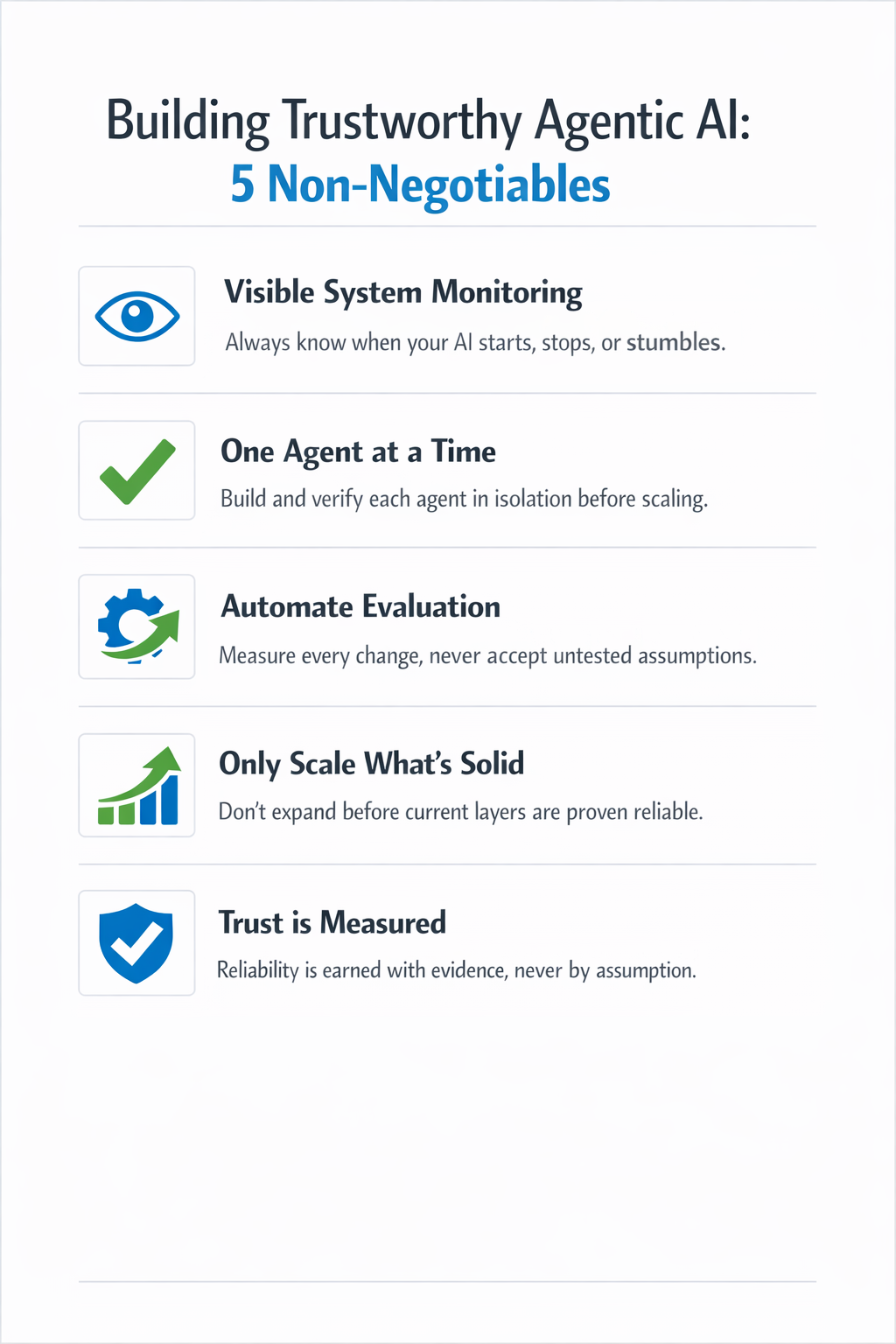
Here’s the good news. If you honour these engineering non-negotiables—simple beginnings, clear observability, stepwise tests, and never cutting corners—you’ll quickly find yourself with an agentic platform that isn’t just clever, but truly dependable. Only from here can AI and automation systems become the force-multipliers they promise to be.
If you let that discipline slip, things drift overnight into chaos. You won’t see failures until they’re too big, your team will lose confidence, and all that shiny AI potential evaporates under the grind of fire-fighting.
Want to apply these principles?
For complete frameworks and actionable pointers, dig in to: