AI
Agentic
Agentic Strategy

So, this all started with me just sitting down, setting up the very first town hall for JUVO Lab in JUVO. There is a lot to share. What we are doing, how things are working at JUVO Lab, and what we want to get out of these big monthly sessions.
But the real story is how I got the job done.
On paper, it is a standard leadership task. Align the team, share progress, set direction. In practice, it is a heavy lift. Slides, agenda, narratives, highlights from projects, who needs to speak, who needs context, and how to make the whole thing useful, not performative.
In the past, that would mean days of writing, cutting, rewriting, and chasing updates. This time, I decided to treat the town hall as an experiment in how far I could lean into agentic work.
Being agentic first is our way. So, rather than prepping everything by hand or typing up pages of notes, I kicked off by building an agentic crew.
I fed it:
It took a little more effort upfront. I had to think clearly about roles, prompts, inputs, and outputs. But the payoff was immediate. Instead of one-off assets, I now had a reusable crew that could:
Next time, I do not start again. I only update the inputs. Each town hall becomes an iteration, not a fresh mountain to climb.
Interestingly, this is not just my personal hunch. As one major consultancy has put it:
"Agentic organisations—powered by AI agents—are fundamentally altering the way work is structured, making processes more iterative, reusable, and responsive to real-time data."
That sentence could be a direct description of what happened in my morning. I built the town hall once as a crew. Now it is an asset for every future session.
While all this was running, I got a full-on flashback to 2008, sitting in the cinema watching Iron Man for the first time.
You know the scenes. Tony Stark in his lab, talking to JARVIS, building the suit in this vivid, living conversation. Holograms. Screens moving in mid air. Constant back and forth as he tweaks, rebuilds, and tests live.
I remember thinking:
I want that. I want to talk to my work like that.
Back then it felt like pure fantasy. A playful version of the future, good for popcorn and nothing else.
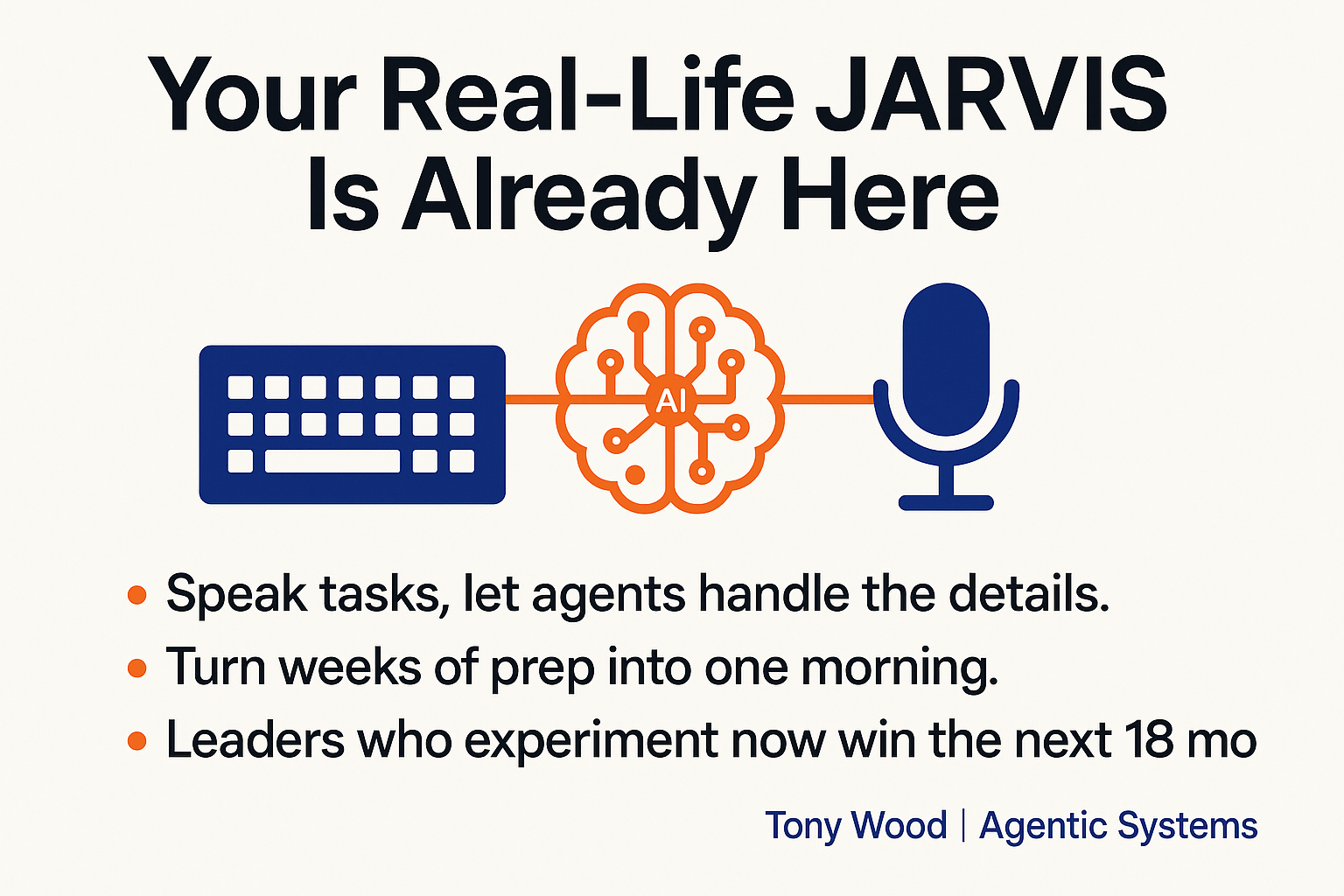
What hit me, sitting at my desk in 2025, was this. I am doing the same thing, in a much less glamorous office chair, with an AI stack instead of holograms. The JARVIS moment is not a demo video any more. It is my Saturday morning.
And this is not only my experience. One writer recently captured that shift perfectly:
"What once belonged in the realm of science fiction—talking to your computer and having it understand, advise, or build for you—is rapidly becoming a normal part of digital workflows, thanks to AI agents inspired by visions like Iron Man’s JARVIS."
That is exactly what it feels like. Sci fi as standard operating procedure.
The biggest mental shift for me has been how I interact with the work.
Instead of hammering a keyboard, I talk to tools like Cursor and my agentic crew in plain language. I explain:
The tooling does the heavy lifting of turning that intent into code, content, structure, and assets.
This aligns with a broader shift in how people are building software and workflows. One description I like puts it like this:
"With vibe coding, you tell the computer what you want in plain English and—almost like magic—the code or component you need is generated before your eyes."
That phrase captures what it feels like when you first drop the habit of “thinking in slides” or “thinking in code” and start thinking in intent.
As a leader, that matters. It means:
The old gap between “I know what I want” and “I can make it real” is shrinking fast.
So what actually happened with the town hall build.
I started at 6am.
By noon, I had:
Historically, that would have been a week of my time, minimum. More if I had to:
Instead, I ran about ten iterations in six hours. Each loop, I could see the result, adjust the instructions, and run again.
Outside my little bubble, the data is moving in the same direction. One major engineering team notes that:
"At a high level, more than 60% of developers surveyed reported that AI coding tools make them more productive, freeing up time that is redeployed to higher-value work like learning new skills, reviewing code, or collaborating with colleagues."
That is the real leverage. It is not just that we are faster. It is that the time we win back can be spent on higher quality thinking, better collaboration, and more experiments.
Another research group studying copilot style tools observed that:
"We observed that Copilot integration can decrease the time required to complete programming tasks while increasing overall code quality and documentation coverage."
Productivity without quality is a false win. The encouraging signal here is that we are seeing speed and robustness improve together when people use these tools well.
My six hour town hall sprint is one small example of the same pattern.
It is tempting to treat this as a cool personal story. Fun, but not especially relevant to the rest of the organisation.
I think that would be a mistake.
What is changing is not only speed. It is the shape of work.
Agentic crews and conversational tools mean:
For leaders, a few implications stand out.
1. You should assume agentic reusability by default
If a task repeats:
This is how you compound learning instead of scattering it in people’s inboxes.
2. Natural language is now a core interface, not a gimmick
If work can be steered by language:
That has big implications for training, hiring, and how you define “technical” roles.
3. Governance has to keep up
When anyone can spin up a powerful crew, guardrails matter. You will need:
The good news is that many of these patterns already exist in software engineering and operations. The shift is that they are now relevant to almost every function, from HR to finance to marketing.
If you are in a leadership role, you do not need to become a full time prompt engineer. But you do need to update a few mental models.
Here are some practical questions to sit with.
This is not about chasing another buzzword. It is about:
The Iron Man reference is playful, but the stakes are real. The organisations that learn to work with agentic crews and conversational interfaces will move faster, learn more, and waste less energy on translation.
The ones that cling to slide decks and manual updates will feel slower and heavier every quarter.
You do not have to start with a full town hall.
You could:
Then, as you gain confidence:
At some point, you may look up from your own desk, or your own kitchen table at 6am, and realise you have had your own JARVIS moment.
What used to be a film effect is now just how you work.
Call to Action: Treat one piece of repeat work as your “Iron Man experiment”. Turn it into an agentic crew you can talk to, then see what a six hour sprint can do. What could you try in the next 24 hours and the next few weeks?
Links:
Quotes: