
AI
Agentic
Agentic Strategy

This is a story about a sore finger that ended up teaching me more about leadership than I expected.
Last week I had a nasty nail infection. Properly swollen. Properly painful. The kind of thing that makes you irrational, because you want it gone now.
And what surprised me was not the infection.
What surprised me was how quickly a group of smart, well-meaning people converged on the same risky plan, with absolute confidence.
Sound familiar?
The infection was around the nail. Paronychia. Painful enough that every decision feels urgent.
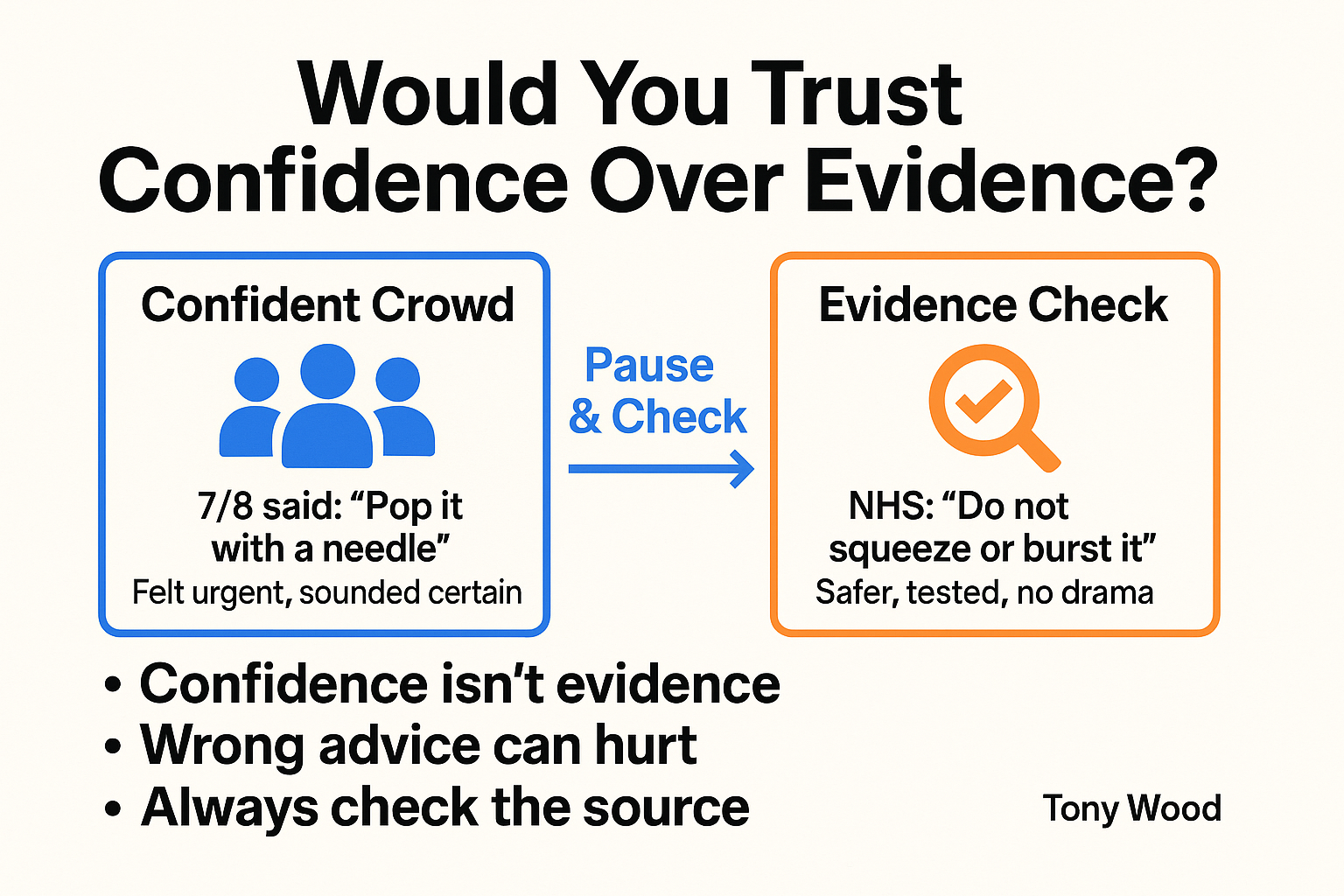
I asked around. Eight people gave advice.
Seven of them basically said the same thing: sterilise a needle, pop it, drain it, squeeze it, job done.
And here’s the thing. When lots of people agree, your brain starts filing it under “common sense”.
That’s the trap.
In leadership, we see the same pattern all the time:
I didn’t trust the needle plan. Not because I’m a medical expert, but because breaking the skin barrier on an infected finger felt like escalating risk, not reducing it.
So I did what I increasingly do when I want a second opinion that is calm, structured, and not trying to impress anyone.
I asked ChatGPT.
Not as a doctor. Not as gospel.
As a decision-support tool.
The model kept returning to the same principles:
Then I did something simple that I wish more leaders did with complex decisions.
I started logging evidence.
I took daily photos and compared them, rather than relying on how it “felt” in the moment.
That changed everything because it turned panic into observation.
After the chat, I cross-checked against official UK guidance.
And what I found was telling. The safe, conservative advice is clear and patient-friendly.
Do not squeeze or burst the abscess yourself.
That is not a niche opinion. That is plain harm-reduction.
I also found practical, low-risk self-care guidance for nail infections.
To help your infection get better, you can soak the affected finger or toe in warm water for up to 15 minutes, 3 to 4 times a day.
And there is a clean escalation line that most of us ignore until it is too late.
See a GP if: your symptoms are getting worse
That trio is a leadership playbook disguised as healthcare advice:
We talk a lot about AI hallucinations.
We talk far less about human hallucinations, the confident folklore, the “my mate did this once” certainty, the overfitted story we treat as universal truth.
In my case, the majority view was not evidence-based. It was vibe-based.
And because it was familiar, it sounded correct.
Leaders should sit with that for a minute, because the same mechanics show up everywhere:
The crowd does not automatically equal the truth.
The crowd often equals the most repeatable story.
If you take nothing else from this, take this.
When you are being pulled towards a confident group decision, run it through a risk filter.
Ask:
If failure is high-impact, you need higher standards than social consensus.
Start with actions you can undo.
In business, that might mean:
In my case, it meant conservative care and monitoring, not skin-breaking heroics.
Do not decide off a single snapshot.
Create a tiny measurement loop:
This is practical experimentation, not bureaucracy.
Write down what “worse” means before you are stressed, busy, or biased.
If you are leading a team, agree the escalation triggers early, in calm time, not crisis time.
In a corporate context, “trusted guidance” might be:
In personal life, it might be NHS guidance.
Either way, do not treat confidence as a substitute for evidence.
Honestly, I would have used the cautious approach earlier.
Because the biggest risk was not the infection.
The biggest risk was me trying to “solve it fast” by following the most confident people in the room.
That is a leadership failure mode, not a medical one.
This week, pick one decision your team is currently “confident” about and run a 15-minute risk filter session:
If you do that consistently, you will make fewer dramatic mistakes and you will build a culture where caution is seen as competence.
Paronychia (NHS)
https://www.nhs.uk/conditions/paronychia/
Trust rating: High
Reason: UK national health guidance with clear self-care steps and escalation advice.
Date written: Page last reviewed: 04 April 2023
Skin Abscess (NHS)
https://www.nhs.uk/conditions/skin-abscess/
Trust rating: High
Reason: UK national health guidance with explicit instruction not to self-squeeze or self-burst.
Date written: Page last reviewed: 05 May 2023
Lymphangitis (NHS)
https://www.nhs.uk/conditions/lymphangitis/
Trust rating: High
Reason: UK national health guidance describing signs of spreading infection.
Date written: Page last reviewed: 28 February 2023
Paronychia (Patient Information) | University Hospitals Sussex NHS Foundation Trust
https://www.uhsussex.nhs.uk/resources/paronychia/
Trust rating: High
Reason: NHS Trust patient information, typically more step-by-step and practical for everyday care.
Date written: Date not supplied in brief
Care Magnesium Sulphate Paste 50g (Package Leaflet) | emc
https://www.medicines.org.uk/emc/product/10796/pil
Trust rating: High
Reason: Official UK medicines leaflet-style content for correct use and safety notes.
Date written: Date not supplied in brief
NHS (Skin abscess)
https://www.nhs.uk/conditions/skin-abscess/
Trust rating: High
Reason: Clear harm-reduction instruction that counters risky DIY advice.
Date written: Page last reviewed: 05 May 2023
Quote used: "Do not squeeze or burst the abscess yourself."
NHS (Paronychia)
https://www.nhs.uk/conditions/paronychia/
Trust rating: High
Reason: Practical, conservative self-care step suitable for general readers.
Date written: Page last reviewed: 04 April 2023
Quote used: "To help your infection get better, you can soak the affected finger or toe in warm water for up to 15 minutes, 3 to 4 times a day."
NHS (Paronychia)
https://www.nhs.uk/conditions/paronychia/
Trust rating: High
Reason: Simple escalation guidance that supports safe decision making.
Date written: Page last reviewed: 04 April 2023
Quote used: "See a GP if: your symptoms are getting worse"